New Coke: A Warning from History

If, like me, you’re British then your knowledge of New Coke is likely to be (a) it was a massive failure, (b) everyone hated it, (c) it was a terrible business decision, and, if your go-to reference for it is The Simpsons then probably (d) the person responsible for it ended up down-and-out, living in a railroad yard with Homer’s half-brother, Herb.

Of course, unless you’re new to the Internet, my very listing of those facts should tip you off that I’m about to debunk them.

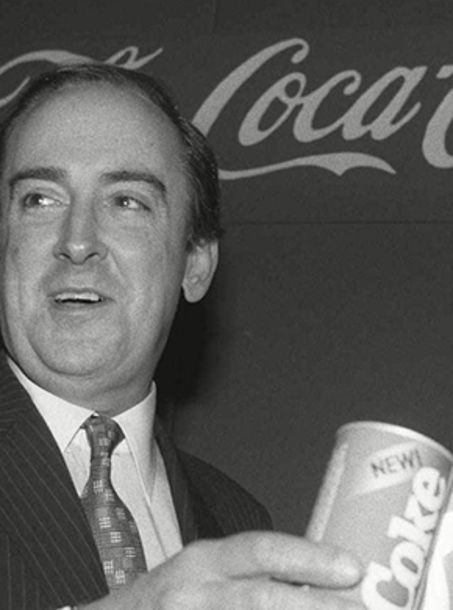
Let’s start at the end of the list. The person most responsible for New Coke was Coca-Cola’s chairman and CEO, Roberto Goizueta, who’d worked his way up from, aged 22, responding to a “Help wanted” ad, placed by a Coke bottling factory in his native Cuba, to running the company before he was fifty. He was not fired for the New Coke fiasco. Nobody was, but especially not Roberto, who continued to run the company until his lifelong smoking habit caught up with him and he died of lung cancer, exactly one month before his 66th birthday, in 1997.

Roberto Goizueta

As you might expect, such a high-flier wasn’t given to terrible business decisions. His previous one, Project Triangle, which gave the world Diet Coke, hadn’t done so badly. The truth is that Coca-Cola had their backs against the wall. At the end of the second world war, for every 5 soft drinks sold in America, 3 of them were Coke. By the start of the 80s it wasn’t even 1 in 4, and Pepsi were gaining ground quickly. Pepsi was far more popular with Generation-X, while Coke’s customers were boomers (literally, people born in the baby-boom, not just old people generally) and the oldest of that generation were about to hit 40, which Coca-Cola feared would mean them abandoning high-sugar drinks and looking for healthier alternatives.

Coke still marketed itself as “America’s favourite cola”, which, as the best-selling cola in the country, it was. However, it had twice as many vending machines as Pepsi and a strangle-hold on fast-food outlets, particularly McDonald’s. In grocery stores, where buyers had a choice, Pepsi was beating them. Coca-Cola spent more on shelf-space, more on advertising, and still Pepsi was creeping up on them.

Pepsi advertising was showing people taste-testing colas, and then being amazed when they picked Pepsi as their favourite. “Will you take the Pepsi challenge,” asked the commercials. Coca-Cola’s own market research told them the same thing; in blind taste-tests, Pepsi out-performed Coke by 10-15 points. It wasn’t even a close battle. Coca-Cola, not unreasonably, concluded that as they were losing a war of taste, they had to change Coke’s taste to win, and that is made sense to tell people they were changing. After all, the goal was to get more people drinking the stuff.

Why, then, did they introduce a product that people hated? This question really played on my mind when I started working in market research, 15 years ago. Had New Coke been market research’s greatest failure?

First off, it’s hard to overstate how seriously Coca-Cola were taking the challenge of finding a new flavour for Coke, named Project Kansas, as contemporaneous documents show.

In its size, scope and boldness, it is not unlike the Allied invasion of Europe in 1944. This is not just another product improvement, not just a repositioning or new product introduction. Kansas, quite simply, can not, must not fail.

Coca-Cola wanted their new taste to be tested on every demographic from every part of America. If you don’t work in market research then, let me tell you, taste testing is a pain in the arse. You can’t just line people up, give them two sippy cups, and keep a tally of which one they prefer. You need to ask them a whole load of demographic questions; how old are they, where are they from, are they a Coke drinker, a cola drinker, are they the main shopper, etc. Then you have to ship supplies of your product and your competitor’s brand all over the country, it has to be stored correctly and served correctly. Then you have to keep a daily eye on the results, if you have one location or even one interviewer who is getting anomalous results then you have to find out what’s wrong. And, remember, this is all happening in the mid-80s. Sure, you can use a computer to compile and tabulate the results, but your information distribution process relies on both manual data entry and fax machines.

If you’re talking about a market the size of America, and you want decent sized demographic sub-sets, then you’re talking about a minimum of, say, 5,000 tests. That is a huge logistical exercise, and a huge expense.

But this was Coca-Cola’s version of winning WWII, so they didn’t do 5,000 taste tests.

No, they did 190,000 taste tests.

And people loved New Coke.

Coke was losing to Pepsi by up to 15-points, New Coke beat it by 8 points. Even established Coke drinkers preferred the new version to the old, more so in non-blind tests, where they were reassured that it was still Coke they were drinking.

Multiple books have been written about New Coke’s failure, and many of them at this point talk about the methodological flaws of taste-testing. What tastes good as a 25ml sample doesn’t necessarily translate into what you want to drink a ½ pint of with a meal, with such an established product it’s hard to separate the branding from the taste, even the colour of the packaging has an effect on how consumers perceive the flavour, etc. The truth, however, is that when New Coke launched the public reception of it was exactly in line with the market research. People liked the product, most Coke drinkers said they’d continue to buy it, sales of Coke went up about 8%. New Coke was a really successful failure.

To find out what really went wrong, let’s wind back to a bit before the product launch. In a gift to all future chroniclers of this topic, Coca-Cola held their final launch/don’t launch meeting on April Fool’s Day 1985. In this meeting at least two serious mistakes were made. The first, and the only part of the New Coke story that Roberto Goizueta ever admitted was a mistake, was that the press launch would make no mention of Pepsi or the Pepsi Challenge. Coca-Cola would not admit they were changing their taste because Pepsi tasted better. The second was to have the press launch in Pepsi’s home, New York, rather than Coca-Cola’s in Atlanta. Both of these decisions would contribute, in part, to New Coke’s failure.

It was also decided in the meeting that the press launch would be on Tuesday 23rd April, 1985, with the invitations to the press going out the preceding Friday. This gave Pepsi as little time as possible to prepare their response.

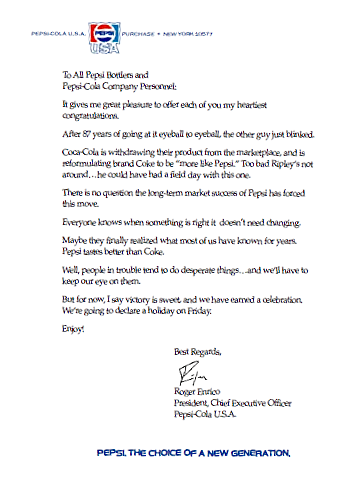
Pepsi, it turned out, didn’t need much time, because on the day the invites went out their Director of Corporate PR, Joe McCann, had an idea so good that he nearly crashed his car. Pepsi were genuinely worried that an improved Coke could derail their taste-test advertising. After all, the Pepsi Challenge didn’t really work if Pepsi didn’t win it. McCann spotted a way to turn the situation to their advantage. He pitched his idea to Pepsi’s CEO, Roger Enrico, and Enrico sent a letter to every Pepsi employee, which was then taken out as an advert in newspapers across America on the morning of New Coke’s launch. Pepsi unilaterally declared that they had won the cola wars.

“The other guy just blinked,” went on to become the title of Enrico’s autobiography, and that letter changed the narrative completely. When Goizeueta opened Coca-Cola’s press conference with the line, “The best has been made even better,” the very first question from the floor was, “Are you 100% sure that this won’t bomb?” Goizeuta, who wasn’t a naturally gifted public speaker to begin with, found himself under fire and, in trying to stick to the decision from the April 1st meeting, allowed himself to be backed into the ridiculous position of claiming that he’d never heard of the Pepsi Challenge.

The press saw the opportunity for a story, and they had some help. A few paragraphs ago I said that the public reaction was exactly in line with market research… well, it was, the problem is that we haven’t talked about all the market research.

As well as their 190,000 taste-tests, Coca-Cola had also done some qualitative research, with focus groups. Naturally, Coca-Cola had favoured their robust quantitative data over what groups of 12 random guys in some rooms somewhere thought. This turned out to be a mistake, because what the focus groups were telling them was that around 10% of people really hated the idea of Coke changing, irrespective of what it tasted like, and that those people bullied and peer-pressured the others in their group into agreeing with them. Their quant research told them that people loved the new drink, and the qual research told them that this was going to be a fucking nightmare. Both were right.

From an editorial viewpoint, “New product is basically fine,” is a far poorer story than reporting outrage over the change, and duly the voice of the minority was amplified. The Washington Post, which a decade earlier had uncovered the Watergate scandal, went with a measured approach to the introduction of a new soft-drink, “Next week they’ll be chiselling Teddy Roosevelt off the side of Mount Rushmore.” Meanwhile, readers in New York were told, “The new drink will be smoother, sweeter, and a threat to a way of life.” The Chicago Tribune called it absolutely correctly, “Changing Coca-Cola is an intrusion on tradition, and a lot of southerners won’t like it, regardless of how it tastes.”

In the South there were protests and boycotts, even cases of New Coke being poured down drains. Coca-Cola’s decision to launch the product in New York, which they saw as taking the fight to the enemy, was re-cast by Pepsi’s letter as a Southern company going to the North to surrender. Because the three most public people behind New Coke – Roberto Goizuerta, Brian Dyson, and Sergio Zyman – were suspiciously foreign – respectively, Cuban, Mexican, and Argentinian – rumours started that New Coke was a communist plot. Rumours, apparently, not dispelled by the world’s most famous communist Coke-drinker, Fidel Castro, denouncing New Coke as a symbol of capitalist decadence.

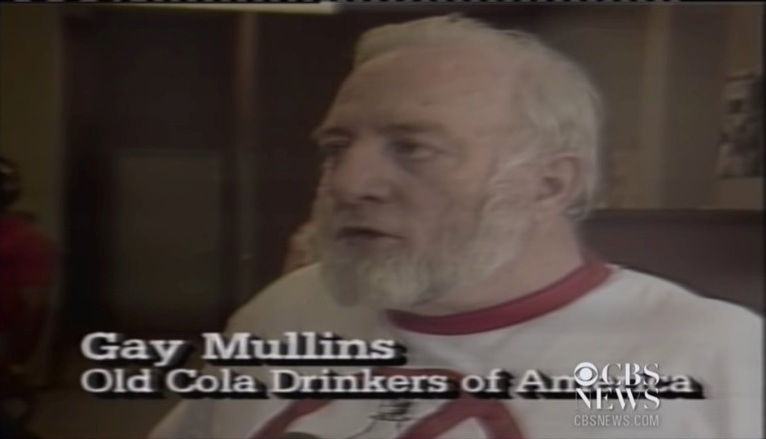
A pressure group formed, Old Cola Drinkers of America, founded by this gentleman…

The OCDoA claimed to have 100,000 members, and to be fighting for freedom of choice, the very nature of America. They launched a class-action lawsuit, to try to force Coca-Cola to either revert to their original formula or to sell it to someone who would produce it. They lost. Mr Mullins then appeared in a series of nationally televised taste-tests, where he demonstrated to the whole nation that he either couldn’t tell the difference between Coke and New Coke, or expressed a preference for New Coke. He then returned to suing Coca-Cola, claiming that his performance in the taste-tests (which, because I need to keep reminding myself this is true, were nationally televised) was due to his taste buds being destroyed by the high fructose corn syrup used as a sweetener in New Coke. He lost that case as well (most Coke bottling plants had switched to high fructose corn syrup years before New Coke, Coca-Cola just hadn’t made a song and dance about it).

Pepsi, meanwhile, were enjoying the sweetness of their rival’s suffering, churning out a new campaign that reenforced the idea that Pepsi had beaten Coke. Some of their adverts were so hastily made that it seems they didn’t even have time to cast people who could act.

With people now trying to import original Coke from overseas, and overseas markets, worried by the disruption in the US, getting nervous about accepting New Coke, which had been planned to roll out worldwide over the summer, Coca-Cola threw in the towel. On July 11th, just 79 days after the launch of New Coke, they announced that they would reintroduce their original formula, labelled as Classic Coke, alongside New Coke. The ABC network interrupted General Hospital with a newsflash, to let America know that Coke was returning.

Coca-Cola got their Hollywood ending. Sales of Classic Coke soared, and it ended 1985 comfortably outselling both Pepsi and New Coke, both products it was quantifiably less liked than. The conventional wisdom became that Coke was a foundational part of America and that people had simply forgotten how much they loved it, a story that Coca-Cola, unsurprisingly, embraced.

Their internal reports, however, revealed quite a different view. They had, they concluded, seriously underestimated the influence that could be wielded, and the damage that could be done, by a relatively small group of angry people.

I don’t think it’s unfair to say that, long before anyone ever used the term in this sense, before social media, even before the Internet had entered American homes, New Coke was cancelled.

It may be the first time we ever had all the ingredients of a modern cancellation in one place; an angry and vocal minority, the press fanning the flames, the argument being spuriously linked to whatever subject could give it unearned gravitas – the Civil War, Communism, freedom of choice – and a clear grifter being given national celebrity status. Most importantly, it won. Not just in terms of getting its immediate goals met, with the return of Classic Coke, but in the public recollection of what happened. A decision made for rational reasons, with ridiculous amounts of preparation, that resulted in a good product, which people liked, is remembered as not only the complete reverse of those things but as the archetype of the opposite.

It’s too late to save New Coke, it settled down to holding about 3% of the soft-drink market and was renamed Coke II in 1990, before being discontinued in July 2002. The following month Coca-Cola announced they were dropping the “Classic” branding, and after 17 years away, Coke was again just Coke. Perhaps, though, it’s not too late to remind ourselves that what people say they want, which voices the media choses to amplify, and what they claim to be fighting for might not be what they first seem, and may not represent what we would chose for ourselves, if we had a taste.

Final note, for the pedantic: There was not, in 1985, a product called New Coke. There was Coke, made to the old formula, which was replaced by Coke made to the new formula. Its common name, New Coke, came from the “New” flash that was printed on the cans, as seen in the photo of Roberto Goizueta. There was, however, a New Coke in 2019. In a tie-in with Stranger Things, Coca-Cola made 500,000 promotional cans, to the 1985 recipe. Demand for them was so high it crashed their website. Some things just won’t stay cancelled.

Who are we?

There’s a very old joke about an English woman on holiday in Germany with her husband, who overhears two locals refer to them as foreigners. “I’m sorry,” she tells them, presumably in an accent used to read the BBC News in 1935, “But you are mistaken. We are English, it is you who are foreigners.”

I didn’t say it was a good joke. Just old.

Germany, pictured yesterday

I do, however, think it’s instructive. It’s commonplace in discussions of English identity to think of us as being xenophobic, afraid of foreigners, but to me it’s always felt more like we’re autoxenophobic… afraid of becoming foreigners ourselves.

The evidence of this is all around us. In her recent Telegraph article, Suella Braverman complains of, neighbourhoods in England where English is irregularly spoken, and you have to ask why the hell that should matter. It matters for the same reason it matters in the timeless English story about how the people in the local shop switched to speaking in Welsh when we walked in, or the one about the snooty Parisian who speaks perfectly good English but refuses to. It matters because those damned impertinent foreigners made us feel foreign.

We do have a long tradition of trying to make sure we are never foreign anywhere in the world. Both by making over there feel like over here – hotels on every continent have learned that they need to provide chips & sausages and none of that foreign muck – and by taking to heart and making our own that which was indisputably foreign but which we could not do without – anyone fancy a curry? We’ve even had a very middle-class counter-culture, of going abroad as authentic travellers, living like natives, sneering at the Spanish chips ‘n’ lager resorts, eating the foreign muck… and the English autoxenophobe rightly regards them all as a bunch of tossers.

Like all phobias, autoxenophobia is silly and irrational, and we can joke about the English lady who believes that being foreign can only apply to others, but it becomes serious when we’re triggered by a neighbourhood where English isn’t the first language, or by a Polish bakery, or a group of orthodox Jews, and that fear, silly and irrational as it may be, expresses itself as anger and violence.

Not that only the “English” get angry, of course. Braverman complains about, clashes on our streets between Hindus and Muslims over conflicts thousands of miles away. And that’s bad, because that makes us feel foreign. When it was clashes on our streets between gangs of charming white gentlemen, stoked by conflicts between two football clubs, 20 miles apart, that was fine, because we understood that without having to watch the foreign section of the news. Not that it’s xenophobic or autoxenophobic to not want violent clashes on our streets, but the answer is a police force that arrests violent people, a court system that impartially sentences them for what they did, and a prison system that has the capacity to hold them, none of which Braverman’s party seemed to think worth funding properly.

Finally, I think I should admit that I am autoxenophobic. I’m a rubbish traveller, I live in probably the least diverse place in England, as a Geordie I’m technically not even fluent in English, my grasp of foreign languages extends exactly as far as, Oon van rooge, sieve ooplay, in the Chinese supermarket I secretly fear that I’m somehow doing it wrong. On the other hand, I don’t like cricket, or ale, and I don’t talk like my front teeth are welded together, so I don’t think I can even lay claim to the green & pleasant lands identity that Braverman is laying out.

On the other hand, I do think our country deserves more of a national identity than us all just being scared shitless of being foreign. If we must, as Braverman puts it, define what it is we are fighting for, then being slightly scared of kolacz doesn’t really seem sufficient to urge anyone into battle. No, instead I propose that we fight for Gogglebox. Yes, the TV programme. When I watch Gogglebox I see people who don’t look like me, who don’t talk like me, who don’t have the same experiences or political beliefs, and I see them laugh at what I laugh at, gawp at what shocks me, cry at what touches me, and take the piss out of most of it, and I feel kinship with them and remember that I live in a country that’s big enough, and strong enough, and self-assured enough to make space for differences, and that’s an identity worth fighting for,

So, it’s come to this… fanfic

[Note: This started as a Bluesky post from someone regretting that we’d never get a Discworld novel that dealt with generative AI. They proposed the wizards creating Large Language Monsters, which ate everyone’s stuff and then regurgitated it, until Vimes arrests them all for being stupid… which is an absolutely terrible idea for a Discworld book.

Still, I did like the idea of a Discworld version of AI, and I do like writing as other people, so I wrote a couple of scenes.

I’ve been reading Discworld for most of the time there has been a Discworld (I bought The Colour of Magic after reading a pre-publication review of Equal Rites in White Dwarf magazine) and I am painfully aware that I am not the writer TP was, but it was fun and oddly comforting to try writing using his voice, so I kept on going a bit. This is the stuff I put on B’Sky, plus some of the additional stuff I wrote. If people like it I may write a little more, if they don’t like it then I’ll probably write more anyway… because I’d be lying if I said pleasing you was high up my priority list.

The problem with this story (other than the low-quality writing) is that Hex, the Unseen University’s thinking-engine, seems like a natural component of any story about AI, but Hex has already been shown using natural language on numerous occasions, even if you don’t count the various Science of Discworld books as canonical. My solution to this is not to care about it. Bugger it, if TP can get away with saying that the Patrician from The Colour of Magic is the same bloke who appears in later books then you can shut up and swallow this.

Finally, I met somebody on a bus who said he was a lawyer, and he said this was all legally OK. If it’s not then you have to take it up with him.]

Scene 1

It was a bad winter. Even in the Ramtops, where winters were often lethal but otherwise lives were long, people were saying it was the worst in living memory. At night wolves were coming into the tiny villages nestled into the mountains, which was unheard of, Ramtops’ wolves, their intelligence heightened by the strong magical field in the area, having long since learned to avoid humans, unless they had them heavily out-numbered, because wolves that didn’t learn this lesson tended up end up as a matching hat, slippers and gloves set. On the plains below the mountains the winter froze the fertile soil and when it reached Ankh-Morpork, the greatest, or at least most noticeable, city of Discworld it hurled tiny icy daggers down the thoroughfares, turned every street into a patchwork of tiny skating rinks, and on the coldest nights got within 20-degrees of the city’s many street vendors deciding not to get out there and sell.

On such a night, Lance-constable Tom Puntpole of the Ankh-Morpork City Watch was walking his first beat but had the good fortune to have Sergeant Detritus accompanying him. There wasn’t a man, dwarf, or none of the above in the watch who didn’t appreciate having Detritus on patrol with them. Even amongst other trolls he was known as someone not to mess with, which meant that situations which might, in smaller hands, have become violent, tended to remain very polite and to get resolved with no sudden movements. Additionally, Detritus’s immense bulk also made him a very convenient weather-break, and any watchman smart enough to know which way the wind was blowing could use him to avoid the worst effects of gales, rain, snow, and quite possibly meteorite strikes.

Now, with winter reducing the city’s temperatures to those more normal for the high ice-fields, where trolls had evolved, it also meant Detritus was smart[1], and as such he’d requested[2] that his young charge be given the beat that took in the Unseen University.

Throughout the year the area immediately around the university was low in crime, because those taken as easy marks by pickpockets, muggers, and assorted members of the street-crime fraternity might also turn out to be a dab hand with fireballs. The lack of crime meant the area was deemed by the watch to be an ultra-low commission zone and the Thieves Guild avoided it altogether, because of the combustion charge. On cold nights, however, the beat past it was the most sought after, as it ran alongside the university’s ever-expanding High-Energy Magic building, which now formed part of the boundary wall. Whatever went on in the building, which was firmly beyond the watch’s jurisdiction, the wall radiated a wonderful warmth which provided comfort for any watchman too cold to care that the wall also vibrated, changed colour, and occasionally spoke to you.

‘How long have you been a copper, sarge?’ asked Puntpole as the pair proceeded by the wall.

‘Two thousand, six hundred and fourteen nights[3],’ replied Detritus, without hesitation

‘Do you think I could make sergeant?’

‘A smart human like you? Sure. Two years, maybe less if you get an offer from one of the other plains cities. Or further afield, even. I heard they’re looking for sammies as far as Uberwald these days. Is being a sergeant what you want?’

Puntpole sighed. He just wanted to feel that there was a future,e but he’d always struggled to imagine a world past the present with a him-shaped space in it. During his childhood he’d met many adults who seemed to regard asking him what he wanted to be when he grew up as polite conversation, but the question had always filled him with dread. Nothing he’d ever tried, irrespective of his talent at it, had struck him as the thing he was meant to do with his life. He’d joined the city watch because it had a generous fund for widows and offered decent pay, a smart uniform, a time off to help him find the lucky lady who could one day be his widow, but even now, on his first beat, he couldn’t form a mental image of himself doing it in two years’ time, or in a year, or even tomorrow. He felt like a jigsaw piece that hasn’t quite fitted into every spot it’s been tried and is uncertain whether more sky needs to be filled in to find their spot or if they’re actually from a completely different jigsaw altogether.

‘What’s is occurring here, then,’ asked Detritus, interrupting his musings. Their proceeding had brought them to a group of three young men lounging against the wall. Basic training had taught Puntpole that this was contrary to the Public Loitering Act and as the three were clearly students it was likely they were also in possession of facial hair likely to cause a breach of the peace, carrying concealed offensive clothing, and probably underage thinking.

The three of them were gathered by the fire-door[4] of the HEM, which was propped open with a thick wad of paper.

‘Good evening, officers,’ said the oldest of the students, causing a large cloud of smoke to escape into the night air. He brought a device, about the size and shape of a hip flask to his lips, tipped his head forward onto its mouthpiece and inhaled deeply.

‘What’s that,’ asked Puntpole.

‘A new invention,’ replied the student proudly, producing another cloud, ‘Smoking without fire.’ He held the device up for inspection. ‘This chamber contains the essence of smoking, trapped in liquid form, and when I press this button here,’ he indicated, ‘A very small spell heats a tiny bit of the liquid, and I breathe in the vapour. Very tricky to get the spell size right,’ he concluded. Puntpole noticed that one of his eyebrows and a portion of his fringe were missing.

‘And it’s the same as smoking is it,’ asked Detritus.

‘Oh yes, all the benefits, without any of the problems. No looking for a light, not having to worry about your ‘baccy or papers getting wet in this weather, no having to roll up.’

‘What benefits,’ asked Puntpole, quietly.

‘We’re thinking of selling them outside the university. They’ve been very popular with the students,’ His two companions held up their own devices, which looked to have been hand-painted. ‘We’ve been trying to think of a name for them. Something that says it’s a quick and easy alternative to smoking. Something like… Smokeless Easy.’

‘Fast sucking,’ suggested one of the other students.

‘Vapour rapid,’ added the final member of the trio.

‘You think this is going to be a thing,’ whisper Puntpole to Detrius.

‘Dunno. Can you smell frying onions?’

Puntpole sniffed the air. ‘No.’

‘Then Dibbler’s not within half a mile. If there was a dollar to be made in this then he’d be here.’

The fire door opened, and a new wizard appeared, slightly older than the other three.

‘Come on, lads, smoke break’s over. We need you back inside. What are you doing here,’ he asked the two watchmen.

‘Just walking our beat, sir,’ replied Detritus, respectfully.

‘Great! We can use you for testing. Give me a question,’

‘Why,’ asked Puntpole.

‘No, we’ve tried that one. It doesn’t work well. Something a bit more direct.’

‘Who was it who held up the Royal Bank of Ankh-Morpork last Wednesday,’ asked Detritus, with a copper’s instinct and, because some ideas were lodged so deep  in his mind that not even his current genius-level intelligence could lever them out, added, ‘Was it you?’

The newcomer considered this for a second before announcing, ‘Yes, that could work. Wait here!” The other students were ushered back inside, pocketing their vapour rapids as they went, and the fire door slammed shut, leaving the two watchmen alone in the night.

‘What was that about,’ asked Puntpole.

‘Wizards,’ said Detritus, dismissively, ‘Always up to something. Still, if it gives us a lead then Captain Carrot will be pleased.’

‘I heard that Commander Vimes was dead against using magic to solve crimes.’

‘Who’s using magic? We’re just asking questions,’ stonewalled Detritus.

There was the sound of a bolt being drawn, and the fire door reopened and one of the students reappeared.

‘Here you go, ‘ he announced, proffering a couple of sheets of paper and, as an afterthought, taking a quick suck on his vapour rapid.

Puntpole took the papers. ‘This is all print, like in the newspaper,’ he observed, ‘You haven’t had time to set two pages of print.’

‘Thanks for your help,’ replied the student, gnomically, and ducked back inside, closing the door behind him.

‘What was that about,’ asked Puntpole.

‘Wizards,’ repeated Detritus, resuming their patrol. Puntpole shrugged, tucked the pages inside his armour, and hurried after him.

Scene 2

Ponder had tried to explain the problem to the Arch Chancellor, this created new problems. Ponder was an extremely bright young man, except in the vitally important field of explaining what he understood to other people. Ridcully, while also possessing a formidable intellect, was a straightforward man to whom metaphor and simile were not a closed book, an undiscovered country, or a riddle wrapped in an enigma, but rather something he failed to understand so completely that Ponder was convinced it must a long-running joke at his expense.

‘Take this book,’ said Ponder, determined to persevere, and picking a book from the top of the pile next to him, ‘You wrote this book.’

Ridcully peered at the cover. ‘Carnivorous Butterflies of Howondaland,’ he read, ‘No I didn’t. It was written by Leopold the Diarist. It says so, right there on the front.’

‘You didn’t in this reality, but L-Space contains every book ever written in every universe, so it contains the version of this book that you wrote.’

‘Is this a trousers of time thing?’ asked Ridcully, suspiciously. Every encounter he’d had with the trousers of time had left him with the distinct feeling that he’d got the gusset.

‘Yes,’ exclaimed Ponder, hopefully, ‘In some universes things happened that led to you writing this book.’

‘What? The same book?’

‘Yes.’

‘And then this Leopold fellow copied it off me, did he?’

‘Ye- No, no. He just wrote the same book.’

‘Doesn’t sound very likely to me. I’m going to talk to Mr Slant about this. Can’t have people copying books I wrote in other universes without paying me for it.’

‘That’s the problem,’ said Ponder, spotting an opportunity, ‘If we connect Hex to L-Space then it will read your book about butterflies and a million other books you wrote in other universes as well.’

‘Right, well, that should be good for my sales then.’

‘Ah,’ said Ponder, coyly, ‘That’s a different problem.’ He flicked to a random page in the book and showed it to Ridcully. ‘Here, this is the Swallowtall Butterfly which is black and yellow, right?’

‘Right,’ agreed Ridcully, ‘Did I do the drawings as well in this book of mine?  I’m really rather pleased with that one.’

‘But if Hex learns from L-Space,’ Ponder pressed on, ‘And you ask it what colour the Swallowtall is then it might tell you it’s purple and red.’

‘Ah, it would be wrong, then?’

‘No, because in the other universe, where you wrote the book, the Swallowtall might be purple and red.’

‘But when I drew it I’d lost my purple pencil, so I did it yellow instead? That’s a shame, I was feeling proud of that drawing.’

‘No, in this universe it’s yellow and black, in other universes it might be purple and red, and Hex will pick whichever answer is most likely.’

‘Right. So it gives you the wrong answer?’

‘No, Arch Chancellor, it will give you a right answer, you might just be reading it in the wrong universe.’

‘It seems to me this Large Language-‘

‘Multiverse,’ prompted Ponder.

‘Multiverse, is going to a great deal of trouble and expense to generate wrong answers. We’re a university, Mr Stibbons, we’re already full of students who can be relied upon to give us a wrong answer, the difference being that they pay us to put up with it.’

Scene 3

The Patrician stared over his steepled fingers at Mr Slant, the city’s foremost lawyer.

‘Are you suggesting, Mr Slant, that this contraption of the wizards should be allowed to read the books for free?’

‘Not as such,’ replied Mr Slant, who was only comfortable with the word free when it pertained to removing one of his lucrative clients from legally mandated accommodation. ‘The payment would be in the form of the inestimable boon this new technology would provide to the city.’

‘The boon provided by,’ the Patrician paused to check his notes, ‘The machine that gives wrong answers?’

Mr Slant shifted uncomfortably. He did not like having the wizards as clients. Traditionally the wizards got around the law by ignoring it and directing any enquiries about its applicability to them into a discussion about how using magic to, say, turn someone into a toad was frightfully tricky, while turning them into something that wished it was a toad was child’s play.

He was also unconvinced by the merits of their case, which was a scruple which had never before bothered him in his long, undead, life. While a great many of his clients came from those who had been very quick to give wrong answers to questions such as, ‘Where were you when the murder happened,’ he didn’t see the purpose of a machine to do so. For a start it didn’t have any pockets.

‘Havelock[5],’ he shrugged, ‘You know how these things arise from time to time; the Golem liberation movement, the printing press, the clacks, and so on. It’s probably best to keep out of their way and let them run their course.’

‘As with the moving pictures fad,’ asked the Patrician, sweetly. ‘I understand you missed the affair at the time, but you probably heard about the city nearly being destroyed by a 50ft woman.’ Not a muscle moved on the lawyer’s face. There was no possible way for the Patrician to know about Slant’s private work to see if the lucrative legal side of the business could be somehow resurrected, but without all the dangerous and unnecessary messing around with actual moving pictures, actors, or anybody in any way creative. Still Slant swallowed unnecessarily.

‘Anyway,’ continued the Patrician, after slightly too long, ‘The Guild of Authors[6] have written to me about this matter. A beautifully crafted note, with quite the twist at the end. They feel that what the university is proposing is no more than common theft. The Guild of Poets is completely averse to it. The Guild of Portraitists and Sculptors have also demonstrated to me that they look on it with anger, and perhaps touch of sadness.’

‘Have the Progressive Artists Guild performed a dance about the injustice,’ enquired Slant, with a dust-dry chuckle.

‘No,’ replied the Patrician, smoothly. ‘They have sent me a note reading, “Don’t let that bastard Slant do this.” I do so admire people who can separate their passion from their business interests.’

Scene 4

Puntpole had never been inside the Great Hall of the unseen university before. It seemed to be mainly a conveniently large space for wizards to argue in. The small team of wizards next to him had been charged with decorating the ceiling for the occasion. He’d listened in as, via each of them talking over all the others, they’d eventually agreed to use a spell called Patmoore’s Sky Alight, which he’d gathered was supposed to make a starry vista appear overhead, before they each in turn admitted they didn’t know that one. This had been followed by a lot of talk of indoor firework spells, which is also turned out none of them had to hand, and then a heated discussion about whether fireballs would work just as well and whether there’d be any collateral damage. They were now arguing over which of them should go and find some crepe paper and glue. A little further away the Arch-Chancellor, resplendent in his official robes, was having a conversation with a harried looking younger wizard, which Puntpole could only hear half of, thanks to the Arch-Chancellor’s lack of an indoor voice.

“I don’t like it Stibbons! Wands smack of conjuration. You start off thinking one is jolly useful and before you know it you’re pulling rabbits out of hats at children’s birthday parties.” There was a pause while the wizard called Stibbons replied, with something which evidently didn’t please Ridcully, “Point it at my throat? Are you mad? You won’t last long as a wizard if you go around pointing magic artefacts at your head[7]?” Stibbons replied, then took the wand, pointed it as his own throat, and spoke.

“Testing.” Stibbons’s voice sounded clearly throughout the hall, momentarily pausing dozens of wizardly arguments. The Arch-Chancellor grabbed the wand, studied it and then held it to his own throat.

A few minutes later, once the tables had been righted again, some students had cleaned up the broken glass, and the unfortunate wizard, who’d been hit by a chunk of stone when a decorative cherub exploded had been carted, off, Puntpole leaned back against a pillar, while he waited for the ringing in his ears to stop. The other members of the city watch were clustered in their friendship groups and, as usual, Puntpole felt there was no place for him. He’d rather have been walking a beat, but Captain Carrot had been very insistent that the watch’s newest recruit should be present for Command Vimes’s celebration dinner. It was at least a familiar feeling. In everything he’d tried, he’d always got the distinct impression that others knew he didn’t belong there.

“BELIEVE ME, I KNOW THE FEELING,” intoned the figure that he suddenly noticed was standing next to him. This wasn’t a watchman, as he was wearing a robe instead of armour, but also wasn’t a wizard. There was no way this figure had been eating hearty dinners for fifty years, or indeed ever. They also tended not to be seven feet tall, and carrying a sythe.

“Am I about to die,” he gulped.

“IT IS A POSSIBILITY,” agreed Death.

“How,” asked Puntpole. The guards were shuffling into their positions for the opening of the celebration, the wizards were finalising the décor and trying to stop the ceiling raining, and he doubted that anybody anywhere thought enough of him to be considerate enough to arrange for an assassin for him.

“YOU WILL FALL TO YOUR DEATH.”

“Here,” questioned Puntpole, giving the very solid flagstones a tap with his boot.

“IN TINLID ALLEY,” replied Death, a shade uncertainly.

“Tinlid Alley? That’s half a mile away. How can I be about to die there?”

“DO YOU KNOW WHAT A QUANTUM LEVEL EVENT IS?” An elderly man, sweeping up the last of the glass and cherub, passed through Death, apparently without noticing.

“Ladies and gentlemen,” boomed the voice of the Arch-Chancellor, as he rose to his feet. The rest of the hall fell into silence. He picked up a few sheets of paper, which bore a striking resemblance to those that had been thrust into his hands behind the High-Energy Magic building. “We are gathered here tonight to commemorate Samuel Vimes,” read the Arch-Chancellor. Vimes, sitting next to him, tried to grimace as slightly as possible.

“We commemorate Sir Samuel,” Ridcully’s brow furrowed slightly, “On this, the tenth anniversary of his death.”

The room waivered a bit, as if in a heat haze. Puntpole felt like he was staring at an optical illusion, he could clearly see the hall decked out in celebratory colours and Vimes giving Ridcully a puzzled look, but he could also see the sombre colours everywhere, and Vimes’s spot taken by a large wreath.

“THIS IS A QUANTUM LEVEL EVENT,” intoned Death, “A GREAT MANY THINGS ARE UNCERTAIN RIGHT NOW.”

“What should I do,” yelled Puntpole.

“TRY TO STICK TO WHAT YOU ARE CERTAIN OF IS MY ADVICE.”

What Puntpole was certain of that moment was that something was poking into his back and a voice right behind him had just said, “This is a pistol crossbow, mister. Put your hands up,” and then the hall was gone and he was falling towards what he assumed were the cobbles of Tinlid Alley.

After a lifetime of crime fighting, it was Commander Vimes’s opinion that there wasn’t a single tool in the police officer’s arsenal more powerful than a criminal’s over-confidence. Anybody planning to crime who truly, deep in their heart, believed that the stupid coppers would never catch them already had one foot in a cell. It irked Vimes that efficient coppering kept leading to an under-supply of over-confidence. When rumours got out that the watch had a werewolf, who could track the smell of guilt, or gargoyles who could watch a given location for days, or a gnome who could ride a hawk and see the city from half a mile up, those of a criminal bent didn’t decide to give honest living a try. No, the bastards started being clever.

One of the weapons the watch had honed to counter this was Sergeant Fred Colon, a one man campaign to prove that the watch could still be lazy, stupid, keen to suspect the first ethnic minority that came to mind, and open to the micro-bribes of free beer, tobacco, and baked goods. Every time that Vimes sensed that the criminal minds of the city were getting under-confident he sent Colon out on a few extra patrols, to build distrust in the police within the community.

Amongst the rank and file of the watch what Colon delivered was rather more more earthly. None of the watch, up to Old Stoneface himself, could remember a time when it hadn’t included Sergeant Colon, and over the course of his long career he’d learned what watchmen liked. Those arriving back at a station he was running, as Sergeant Detritus and Lance-Constable Puntpole now did, could be sure of a roaring fire, a strong mug of tea, and no difficult questions viz-a-vis a slight odour of ale, a pocketful of baccy, or a few pastry crumbs on your collar.

The wave of heat hit Puntpole as soon as opened the door. After a long patrol in the freezing weather it was like stepping into a furnace. The air in the doorway, where the cold front met the Colon-heated blast, shimmer like a desert mirage, and hung with the scent of tannins and biscuits. Detritus, who had spent the last mile of the patrol constructing an elegant and simple proof of Fermat’s Last Theorem with every rhythmic step, felt his intelligence being stripped away now that there was no more room to march on.

In long-standing watch tradition, the pair of them grabbed a mug of something hot and didn’t speak until it was drained.

‘What’s on dem papers the young wizards gave you,’ asked Detritus, once this ritual had been completed.

Puntpole retrieved the folded papers, now slightly dampened at the edges by inquisitive snowflakes and unfolded them.

‘Your many years people have created theories about who robbed the Royal Bank of Ankh-Morpork,’ read Puntpole.

‘It can’t have been that many years,’ said Detritus, ‘It only happened last Wednesday afternoon.’

Puntpole shrugged and continue reading. ‘Evidence now suggests that the crime itself was committed by Havenot Bugler, Karl Smiterson (commonly known as ‘Shins’), and Robert Levees, all residents of the Shades district of Ankh-Morpork.’

‘I don’t reckon it was Bugler,’ chimed in Colon, who’d been listening with interest, ‘He doesn’t do bank jobs these day, what with him having been buried up at Small Gods for the past three years.’

‘O, dat’s a good alibi,’ offered Detritus.

‘There’s more,’ said Puntpole, ‘Although these men were the ones who carried out the robbery itself, the complex nature of the crime and the choice of target suggest that it was masterminded by criminal genius Professor Moriarty.’

‘Who’s Morry Arty,’ asked Detritus.

‘Probably short for Maurice,’ suggested Colon, ‘Maurice Arty. Doesn’t ring a bell.’

‘I don’t think it’s Maurice,’ said Puntpole, ‘It’s all one word, Moriarty, look.’

‘I knew a Quarry once,’ mused Detritus, as Sergeant Colon walked round to look at the paper Puntpole was holding.

‘Ah,’ exclaimed Colon, triumphantly, ‘This is print, like the newspapers use. They make mistakes all the time. Remember last week, when that hublands king visited the city, the one who commanded the tide not to come in? Well, The Times spelled his name wrong. I nearly widdled meself when I saw it. They had to print an apology the next day. Apparently, the Patrician was furious, what with the king being here on a goodwill visit[1]. I heard he had the palace guards arrest the editor and…’ Here Colon paused and looked around to see who was listening with such an exaggerated conspiratorial air that half a dozen watchmen on shift-change, who had been paying no attention to the conversation, leant in to hear the whispered details of what the Patrician did.

‘That can’t be right,’ countered one of their number, once Colon had finished his lengthy description. ‘I saw Mr de Worde this morning and he was fine. Wasn’t even walking funny or nothing.’

‘Well, I expect he’s been told to hush it up,’ countered Colon, ‘When the Patrician makes an example of someone he doesn’t want everyone knowing about it, does he?’

There was a moment of silence, while the assembled guards considered this wisdom.

‘So,’ continued Colon, cheerfully, ‘Professor, eh? Now, that could be the university, or the Teacher’s Guild[2], or… ‘ He paused and a worried look crossed his face. ‘Oh no! Not them bastards.’

‘You alright, sarge?’

‘It’s a misprint, isn’t it,’ stammered Colon. ‘It’s no Morry Arty. It’s Professor Merry Arty, and that’s a clown name if ever I heard one.’

‘Are you sure, sarge,’ asked one of the watchmen, nervously. No-one who’d ever set foot inside the Fools’ Guild ever wanted to do so again.

‘You mark my words,’ replied Colon, ‘This one is going to turn out to be a real three pie problem.’


[1] So much goodwill was exchanged that the king needed 3 carts to carry his new stash of weapons. He left Ankh-Morpork with an agreement of favourable terms on future weapons purchase, if he protected clacks towers in his territory, and also with, like most visitors to the city, the lingering taste of sausage in a bun in his mouth, an embarrassing rash, and considerably less gold than he arrived with. However, not being a Morporkian-speaker, the question of why the misprint of his name had caused such hilarity would remain forever a mystery to King B’totom.

[2] The sign outside the Teachers’ Guild, reading Teacher’s Guild, was their principle recruiting tool. Many a pedant had rung their bell to correct the error, received a sharp tap to the back of the head, and awoken chained to a year three geography classroom.


[1] The silicon-based troll brain is optimised to run at very low temperatures, and in such conditions they can achieve intelligence surpassing that of humans. This was why Commander Vimes had recently recruited three trolls with particularly sharp sub-zero minds to form a small unit who worked from an office in the city’s freezing pork futures warehouse, re-examining reports on old crimes that had baffled the watch. Technically they were the cold cases team, but to the rest of the force they were simply known as the new bricks.

[2] People tended to grant Detritus’s requests, as it might be hurtful to make him insist.

[3] Trolls, as a naturally nocturnal species, did not count in days

[4] As the HEM housed a great deal that was secret, dangerous, or at least unwise, Ponder Stibbons, the member of the university facility who oversaw it, had gone to great trouble with its security. The main door lock was a sturdy metal box, into which the aspiring entrant had to insert a punch-card. This turned on a light, which shone through the holes in the card and awoke the team of imps who lived in the box. They compared the pattern of lights to the diagrams they’d been given for valid users and, if there was a match, noted which one it was in a tiny log and then unlocked the door. A final imp was used to deliver a buzz or a beep sound effect, to indicate success or failure. This led those seeking ingress into a small room, with a door ahead of them that sported an eye, crafted of quart and ruby, which scanned their thaumatic signature, unique to each wizard, before dropping a counterweight that lifted the heavy steel bar behind the door. Passing the magelock led into a larger room, containing Pascoit the troll, who struggled to tell one human from another, but who could be relied upon to remember a new secret word every month and trusted to deal harshly with anyone who couldn’t do likewise.

In his design of this security system, Ponder had failed to take into account how much trouble all this would present to someone who just wished to pop outside for 5 minutes, so within a week of its installation a fire door had appeared in the rear wall of the building, to let the smokers out. It was secured by a 30 pence bolt from the Street of Cunning Artificers.

[5] Mr Slant was one of the few people to address the Patrician by his first name. This may be because, as a zombie, he had less to fear than most from a ruler with the absolute right to have anybody he wished put to death, or it may be that his sharp legal mind had reasoned that a man who allegedly read secret reports on everything that happened anywhere within the city couldn’t possibly find his given name to be in top one million most objectionable things he’d been called.

[6] Fiction writing on Discworld, which walks the tightrope between the real and unreal, is a dangerous occupation. A skilled writer may find that he has literally brought his creation to life. The Discworld’s writers tend, therefore, not to go out of doors more than they need to, especially if they have created cunning and dangerous antagonists, lest they become a victim of their own success.

[7] Until relatively recently, advancement through the ranks of wizardom was achieved by ensuring one’s immediate superior was not so much impressed as interred. There were times in the university’s past when senior wizards had a body-count exceeding that of their counterparts in the Assassins Guild. Ridcully’s tenure had ended this practice, as he seemed unkillable, always carried a loaded crossbow on his person, and nobody who knew him wanted to risk being haunted by his ghost. Even so, a wizard who accepted a magic item from a subordinate and was willing to follow instructions to point it at their head and then say the magic world was a wizard who was not going to go very far, except maybe in pieces.

A Whopping Porky

How nice it is to have reason to celebrate on International Men’s Day, coming, as it does, at the end of a decade of unprecedented, and long overdue, gains for men. This year’s cherry on the top of that decade is the creation of the slogan for disenfranchised men everywhere, ‘Your body, my choice.’

It has taken a long time for the worm to turn. While my wife was on night-shift last week, I took the opportunity to watch a little-known art-house film from 1981, called Porky’s. It was shocking to see its portrayal of period, within my lifetime, when some high-spirited young men, who merely wanted to see their female-identifying classmates naked in the shower, had to do so illicitly! Those poor boys faced social disgrace, disciplinary action from their school, or even criminal charges, should they be caught doing nothing more than secretively viewing naked girls.

One of the early calls for great rights for men

Amazingly, Porky’s wasn’t the only film brave enough to tackle this grave injustice. Seven years earlier Robin Askwith, in a gritty portrayal of working-class Britain, Confessions of a Window-Cleaner, had cheerfully quipped, “Blimey, they’re big for their age,” while watching a bevvy of schoolgirls shower. The US film industry was also inspired by Porky’s brave crusade for better rights for men and produced titles such as Revenge of the Nerds; one of the first films to examine the plight of incels. By 1990 even national treasures Robbie Coltrane and Eric Idle had joined the cause, as they used deception to watch naked girls shower in Nuns on the Run.

This was, however, a last gasp in the darkness, as we entered two decades of humourless radical feminists shrilly screeching that it was somehow wrong for men to use subterfuge to cop an eyeful of some unsuspecting birds. The Sun’s page 3 vanished, actual laws were brought in against upskirting, on film and TV we were rarely given a gratuitous shot of a pair of knockers. Honestly, if it hadn’t been for the Internet, and its vast amount of free and degrading pornography, it might have been all over for men.

It’s truly incredible, then, to find that in the past decade we have managed to turn the tide so completely that we can have school policy actively inviting young men to get into the showers with their female classmates, public facilities, such as swimming pools and gyms, being scared to exclude men from their changing rooms, lest the force of the law fall upon them, and even women themselves reluctant to object, or even give a little scream, in case social opprobrium should label them a bigot.

We men, ALL men, should be eternally grateful to the few who realised that, by claiming they were women, they could not open every door to every man who doesn’t have the decency to stop at the threshold, but that they could also tear feminism in half, as some women argue that a group which has absolutely no barriers to any man joining it somehow poses no threat to women.

Is there a man whose heart does not swell when they see one female tell another that her feminism is not valid, because it does not recognise the rights of men? Is not that same heart fit to burst when a woman is told that she’s not qualified to speak about boundaries for women’s spaces, because she’s not a man claiming access to them?

This has, truly, been a glorious decade, as we marginalised men have been able to tell women that women are against them, the law is against them, history itself is against them. To the men who have fought so hard for this, congratulations. This International Men’s Day is your day! “Your body, my decision,” is your legacy, and your crown. Pick it up and wear it with pride.

One step

For a long time I’ve been scared of Alcoholics Anonymous.

Not, you understand, that I’ve ever been to an AA meeting or even, to my knowledge, spoken to anyone who has, but they still scared me. I’d like to say that, as a life-long atheist, it was because it was all a bit religious for me. Four of their 12 steps explicitly mention god, and a further 3 allude to religion.

Or, I could say that I don’t have any good stories to tell. When they all sit around and say, “My name is Cthulhu, and I am an alcoholic,” they then have to launch into how they hit rock-bottom (I am basing all this on what I’ve seen on TV, remember, so this may not be accurate). Anyway, I never hit rock-bottom. I’ve never physically hurt anyone because I was drunk. I’ve never been waiting outside a pub at 9am. I’ve never chugged Brasso or meths. I’ve never even been sick through drinking or missed a day’s work because of a hangover.

No, what scared me, as a drinker since long before it was legal for me to be so, was that they wanted me to give up all alcohol forever. That was terrifying. The thought of never having an alcoholic drink ever again. Not having a bottle of wine on a Thursday evening, to celebrate it being nearly the weekend, or seeing in the actual weekend with a couple of cans after work on Friday, or chilling with a nice white on a Saturday night, or a few G&Ts at the end of a Sunday, or 5 or 6 pints at the midweek quiz night.

I mean, I could see their point… real alcoholics probably did need to give it all up forever, but I wasn’t one of them. I was just an ordinary person, living a functional life, quietly drinking my 50 or 60 units a week, every week. Sure, I could see the argument for showing a bit more moderation, after all, I did have my fair share of mornings where I promised myself I’d cut down a bit.

Then I never did.

And nothing bad happened. Life went on. There were no health scares. No waking up in a gutter. My wife didn’t leave me. I didn’t become estranged from my children. I wasn’t arrested for drunk-driving. I didn’t lose my job.

If I was sitting in an AA circle of chairs now, clutching my cup of coffee, with the rest of the group waiting for the point of my story, I’d feel like a Call of Duty player at a trauma counselling session for military veterans. Instead, on 2nd July last year, I had a fairly quiet evening – 3 or 4 of those little 25cl bottles of French beer, and woke up the following morning with the decision in my mind that that was it for me, and I stopped drinking.

We’ve reached the point where I tell you how much better I feel, that I’m more alive, that I’ve saved enough money to buy a Ferrorghini, and I’m bursting with – licks eyebrows – vigour. Well, I’m going to let you down as badly as my imaginary AA group. I don’t feel any healthier, and I’m still driving a 16-year-old car, and packing 2 inches of wet spaghetti in the trouser department. Instead I’ve had a year of little fears; how do you get through a weekend without drinking, what do you do on holiday, how do you go out for a meal, or meet with friends, how do you do a dry Christmas or New Year’s Eve, what does one do on one’s birthday sober?

Turns out they’re all fine. You just don’t drink. I don’t even have a tale of battling my demons. I did worry that not drinking would make me dull, but then I remembered I’m dull anyway, and at least now my dullness is at the correct speaking volume, coherent, and I can drive myself home when you get sick of me.

There you have it, then. My turn in our little virtual AA meeting is over. Give a polite clap, go get another coffee. No hurry, I’ll wait. My name is Andrew and I’m not a real alcoholic. I’m one year sober, proud of myself, and I’m not scared of forever any more.

You’ve got to laugh

Were you lucky enough to be a sympathetic MP or local councillor during the summer of 1979, you might have received a letter from an organisation calling themselves The Festival of Light, enclosing the script for a scene from a forthcoming film. The Festival described the film as “sick,” and, “veering unsteadily between sadism and outright silliness,” and wrote to prominent individuals in an attempt to have it banned. The film was Monty Python’s Life of Brian and the scene used to denounce it was the one where the hapless Brian, pursued by a crowd who’ve become convinced he’s the messiah, ends a hermit’s 18 year silence by landing on his foot.

Some councils did ban the film; many without ever having seen it, some without knowing who The Festival of Light were, and a few with their decision presumably made easier by them not having any cinemas in their jurisdiction. Not that it mattered, the film did become fairly well known. You’ve probably heard of it.

Almost as well known is the interview where Malcolm Muggeridge and the Bishop of Southwark faced off against John Cleese and Michael Palin, to debate the merits of the film. The Pythons later claimed that Muggeridge and the bishop had turned up 15 minutes late for the screening, so had not been aware that Brian was not Jesus, but Muggeridge was a fairly recent convert to Christianity, having claimed to have witnessed a miracle, so you have to wonder just how much that hermit scene, where the followers witness the “miracle” of the juniper bush bringing forth juniper berries, stung him personally.

Jesus, pictured yesterday

Which sort of brings me to my point. Why was the hermit scene the one that was sent out? If you wanted to accuse the film of blasphemy then why not a scene where crucifixion is made out to be no big deal, or the public stoning, or the wise men who don’t know which cowshed they’re meant to be in? The answer is that the people being mocked in the hermit scene are the crowd, the run-of-the-mill believers. The Festival of Light was Mary Whitehouse’s campaign vehicle, and it was her constituents who were the butt of the joke; the people who kept faith on the basis of little tangible evidence.

For a film that it constantly cited as poking fun at religion, Life of Brian does almost nothing of the sort. Jesus’s manger is bathed in heavenly light, his sermon on the mount is treated reverentially, we meet an ex-leper who has truly been healed by him. Nor does it shake a stick at the church’s many sins, condemn the pope and his bishops, or rattle the establishment in any way. It takes a crowd of nameless, powerless, unimportant people, who desperately want something to believe in, and mocks them.

For all the other horrors of the late 70s, we were at least spared James Acaster, but it’s easy enough to imagine him cocking around the stage telling us, “You know who really needs to be brought down a peg or two? Those ladies who organise the jumble-sales and the church cleaning rota. Oh yes, they really need to examine their privilege. Well done, you brave little atheist boys.”

Which is why it was a surprise to see the friend of male fetishists everywhere, Sooz Kempner, listing the attempt to suppress the film amongst her examples of just how bad things were in the comedy olden days.

Or maybe I’m being too harsh on her. Perhaps if a comedy film came out today that so openly “punched down” against a group of people who believe in something ridiculous for no Earthly reason, then she wouldn’t be yelling about it to anybody who’d listen to her.

Aye. Maybe.

Galileo, (Galileo), Galileo, Give me a go!

The Galileo story, as embedded in the general consciousness, is that Galileo looked through his new-fangled telescope at Jupiter, saw 4 moons orbiting it, and realised that he finally had proof that not everything orbited Earth… that we weren’t the centre of the universe. The overbearing church put him on trial for this heresy, found him guilty, and forced him to recant his views. Defiant to the last, Galileo tells them E pur si muove, normally translated these days as, “Fuck you, Mr Pope, you can silence me, but the truth remains true.”

In that form, it has become a parable for everybody who believes that they are the little guy, but with the facts on their side. 

In a way it’s a strange position to want to be in. Sure, Galileo is revered now and the four moons he discovered are collectively named after him, but he was hardly a winner at the time. After his trial he spent the remainder of his life under house arrest. Everything he’d ever written was banned by the church, with his final work having to be printed in protestant Holland. His parting quip, if it was delivered at all, almost certainly wasn’t delivered as defiantly as it is in the popular imagination. When the court has just commuted your sentence of imprisonment at the hands of the inquisition to house arrest, but absolutely has the power to reverse that, and throw a spot of torture or death into the mix, you tend not to leave the building yelling, “Urban warfare now!”

queen
The four Galilean moons, pictured yesterday

Nor was the church’s position as irrational as we like to think. They did support geocentrism – the belief that the Earth lies at the centre of the universe – for scriptural reasons, but there were scientific arguments for it as well. The one we commonly overlook is that it worked. It allowed astronomers to calculate, quite precisely, where planets would be.

If you’re puzzled as to why a fundamentally wrong model delivered correct results, the answer is that it had been wrong for a very long time, and had gradually been gamed to match observations. Because a simple model of everything going circles around the Earth wouldn’t fit with the motion of the planets in the sky, they had been modelled so that they not only orbited the Earth, but also went in their own little circular orbits, called epicycles, which matched predictions to observations.

Also, without geocentrism, there was no mechanism to explain why things fell down when you dropped them. Newton’s theory of gravity was still half a century away. In its stead the idea that everything fell towards the centre of the universe seemed to make some sort of sense.

It’s easy to laugh now, but just how sure are you that if you’d been alive in the 1630s you’d be calculating the gravitational constant, rather than olde-times tweeting, “Just what does everything fall towards, Galidildo?”

There are lots of other factors at play as well. Although we often think of the battle as being between the church’s geocentric model, dating back to Ptolemy, and the heliocentric model of Copernicus, there was a third system in play. Developed by Tycho Brahe, the 2nd most famous person to have an artificial nose, after Michael Jackson, this model still had the Earth at the centre, with the sun orbiting it, but now the other planets orbited the sun. The church was fine with this – geocentrism was what they were wed to – so presumably would have been fine with Galileo’s moons orbiting Jupiter, as it orbited the sun, which orbited Earth.

While it’s not exactly elegant it does skewer the simplistic view that Galileo had observed something orbiting a body other than the Earth, and this was concrete proof that the Earth wasn’t the centre of everything.

There’s also the matter of the timeline. The church ordered Galileo to stop supporting the heliocentric model in 1616 after, it must be said, a fairly disastrous work by him, that suggested the movement of the Earth orbiting caused the tides (which had to side-step its own conclusion that there should only be one tide per day, by hand-waving and suggesting the second tide was probably just the water sloshing around). Yet Galileo’s trial wasn’t until 1633. Just what had happened in the 17 years between?

The answer, rather fatally for the Church vs Galileo view, is that the Pope asked Galileo to write a book comparing the arguments for and against geo- and helio-centric models.

In 1623 Maffeo Barberini had become Pope. Although he believed the Earth was the centre of the universe he was a friend of Galileo, admired his intellect, and had opposed the church’s sanction of him, 7 years earlier.

The Pope laid down some ground rules for this new book; Galileo had to be neutral and not clearly favour the heliocentric model, and he had to present the Pope’s own views and arguments as part of the work.

This should have been the turning point. This was the motherfucking Pope sanctioning a book that could fully discuss an idea that had been absolute heresy only a few years earlier. Heliocentrism was a much simpler, more elegant, idea than the wheels-within-wheels of the Earth-centred models, Galileo had answers to many of the more obvious questions it raised, like How come it doesn’t feel like we’re moving, and it even explained phenomena, such as the newly observed phases of Venus (like the phases of the Moon, caused by the comparative positions of Earth and Venus in relation to the Sun) that the other models couldn’t. A side-by-side comparison of the two should have been an open goal.

So what went wrong?

Well, Signor Tides-Are-Splishy-Splashy-Water screwed it up.

Because the book was intended for the educated, but not necessarily scientific, audience it was not written as a dry textbook. Instead it takes the form of a conversation, over the course of 4 days, between two educated natural philosophers and a lay-person.

Salviati takes the side of the heliocentric model, while the Pope’s favoured geocentric system is represented by…

Simplicio.

He called him Simplicio.

Simplicio gets muddled by his own arguments, has his points against Salviati easily answered, and his own assertions disproved.

Which kind of brings me back to what my point was, 1,000 words ago – Galileo was cancelled, to use modern terminology, but he was cancelled because, given a platform, and with the facts firmly on his side,  he wrote a whole book to which the glaring subtext is The Pope is a stupid shit-head.

And perhaps that’s the real lesson of the Galileo story – not defiantly shouting that you’re right as you’re dragged out of the room, but remembering that, even when you’re right, powerful people who’ve been wrong for a very long time are still powerful people, and if you’re given a chance to change their minds it might be wise to avoid hubris.

After all, nobody really wants to be Galileo, and it’s better to be proven to be on the right side of history before it becomes history.

Wither feminism?

“If your feminism doesn’t include trans women,” a tweet from music journo Emma Wilkes informed us, “It’s not feminism.”

Exhibit A

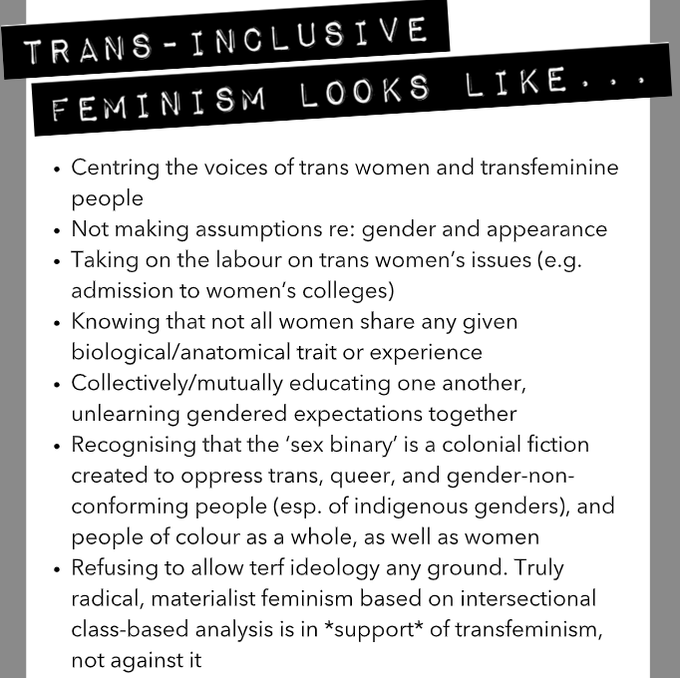
Now, I’d be the first to admit that my knowledge of feminist theory wouldn’t fill a Show Me Your Tits! baseball cap, but I can read. For example, 5 years ago I read the Cambridge University Students’ Union Women’s Campaign’s guide to trans-inclusive feminism. The guide has now been removed from the campaign’s website, presumably for excessive saying-the-quiet-bit-aloud, and replaced with guides on Trans Inclusion and How to Spot a TERF (plus a guide to support for student sex workers… you know, for the ladies) but it still offers a fascinating insight into just what trans inclusion does to feminism.

Exhibit B

The very first point concedes that trans-inclusive feminism is not content with being merely trans-inclusive, it must be trans-centric. This pairs nicely with the second point, reminding us that trans activists have fought furiously against the notion of passing – looking like a biological woman – being any sort of barrier.

In other words, this version of feminism is one that promotes any man who says they’re a women over people who merely are actual women, even if their commitment to feminism doesn’t extend as far as shaving their beard off.

Not that the non-men women have nothing to do in this new, exciting feminist movement. Just look, they can fight for more rights for men who say they’re women (point 3), teach other women to respect the men (point 5), or just attack women who won’t believe the men are who they say they are (final point).

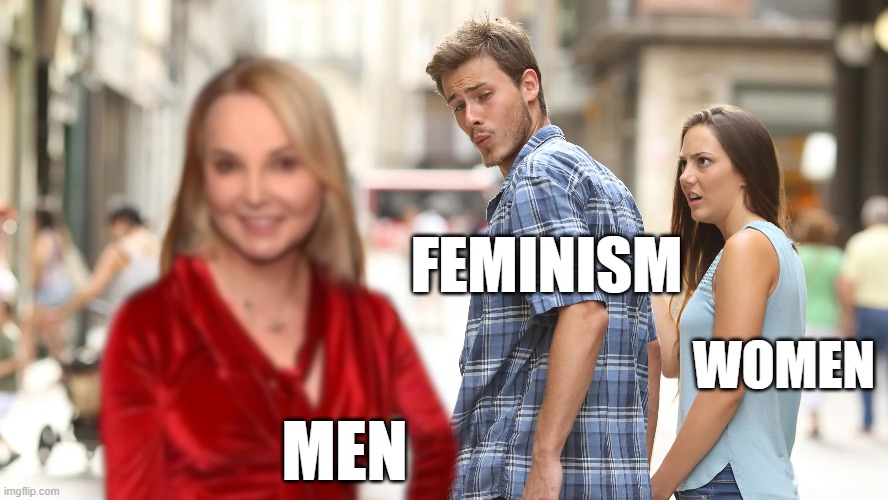
They even get to be one-third of this meme about feminism!

Two mysteries remain. Firstly, who wrote that guide to trans-inclusive feminism? It’s easy to assume it was a transwoman, keen to advance their own interests, but Emma’s tweet – delivered on International Women’s Day – reminds us that there are plenty of women who are desperately eager to advance men’s interests over their own.

The more enduring question, however, and one that’s bothered me for five years, is why it didn’t end then. Why anybody with any desire to claim to be a feminist didn’t read that list of demands and immediately see that they were dealing with a wholesale attempt to take over the political structure of women helping women.

Unfortunately, Emma turned off replies to her tweet, so I can’t ask her. That’s fair enough, feminism shouldn’t be about meeting the demands of men, I’m just not sure anybody’s explained that bit to Emma.

General election, how!

How would you feel if I told you that an early general election was within the gift of a few thousand people, who are working away for less than £3/hour?

The price of an election, pictured yesterday

Disbelieving, I’d imagine. Things like general elections are decided upon in the corridors of power, in the smoky back-rooms, over glasses of very fine brandy, not by those working for sweat-shop wages. Take a step back. Why aren’t those in power clamouring to get the plebs to a plebiscite? You don’t need a degree in political science to know that they’re worried, not unreasonably, that they’re going to get their arses kicked.

Take another step back. Why do they think they’re going to be thrashed like a ginger step-child? Once again, it doesn’t take the brains of Sir Professor Curtice to know it’s because that’s what the polls are telling them (and, one suspects, having burned through the spectrum of prime ministers from knows what to do / can’t get it done, on to doesn’t care what’s done / can’t be arsed to do it, then not a clue what to do / does it anyway, before landing on doesn’t know what to do / scraps plan to do anything and moves on to a new plan for something they also don’t know how to do, they must realise by now that they deserve it).

“String the fuckers up!”

OK, one final step back. Where do they come from? The polls, not the incompetent prime ministers.

In the olden days they used to come from people standing around in places with a high footfall, clutching a clipboard, and desperately trying to get anybody passing to give up 5 minutes of their time. Then it moved to waiting until people were in the bath, and telephoning them at home, to ask for their valuable opinion. The problem with both these methods is that they take ages. Street interviewers are lucky if they can get 30 interviews in an 8-hour shift, telephone interviewing is roughly the same (but you don’t get wet and have less chance of being mugged). If you want to ask the voting intention of 1,000 people then you’re looking at forking out a lot of money.

Fortunately, with the rise in popularity of the Internet, some bright spark noticed that it was filled with people who wanted to give their opinion, all of them doing it for free, and most at volume. What if there was a way to formalise that arrangement, and pay them a small amount to give their opinion in the form of some sort of questionnaire? The panel company was born.

These days, if you want to know what, say, 500 people think of your toothpaste advert, you don’t waste time hanging around street corners, you just rock up to one of these panel companies and say, “Give me a 500 nationally representative sample, please.” They then send your on-line survey out to however many people it takes to get 500 of them to complete it, and a day later, for a couple of hundred quid, you’ve learned what people willing to answer your questions for 20p think of your brand.

“Jesus, it’s all the same! I don’t care! I buy the one that’s on special offer!”

Polling works in exactly the same way. It’s the same people who agreed that “Crestgate gives me mouth-confidence,” who tell you who’s going to win the next election. When you see people querying polling results by saying, “I’ve never been asked, and neither has anyone I know,” that’s because they haven’t joined a panel and frittered away their wanking time deciding whether “Whitening” or “Gum protection” is their #1 priority.

These panel companies like to boast about how many hundreds of thousands of people they have signed up and, sure, hundreds of thousands do sign up. Then the new sign-ups get too few survey invitations, or too many, or they never work out how to stop them going to their spam folder, or they find the rewards too small, or the questionnaires too boring, or they make a friend… whatever. The point is that there’s a core of committed, engaged panellists, and they likely belong to multiple panels, so there’s probably only a few thousand individuals. A tiny number.

And they’re the ones giving Rishi Sunak a squeaky bum.

But they don’t have to. It’s not like they’re under oath to tell the truth when they fill in their polling surveys. If they started lying then the polls would move. The only thing stopping these people giving the Conservatives a 20, 30, even 40 point lead – and thereby tricking them into thinking it’s safe to go to the polls – is their self-respect. AND THEY’RE RATING TOOTHPASTE FOR COPPERS!

I urge these panellists, and I’d like you to join me in this, to abandon whatever principle is driving them to honesty. If you don’t want a Conservative government, all you have to do is say that you’re desperate to vote for one. Claim, however unlikely, that Rishi Sunak would make the best Prime Minister. Rate scrapping inheritance tax, making electric cars illegal, and ritually murdering foxes as your highest priority issues. I implore you, lie like your life depended on it.

Come on, there’s 20p in it for you, and we promise we’ll stop asking about the fucking toothpaste.

Reform School

When it comes to the gender recognition act there are two kinds of people; those who don’t know what it is, and those who don’t like it. It’s so rare for trans-rights activists and gender criticals to be united on any subject that it’s really remarkable that one relatively short act has managed to bring them in agreeing that it’s terrible.

If you’re one of the people who doesn’t know what the act is then, to use its own introduction, it is An Act to make provision for and in connection with change of gender. In other words, when a bloke decides he’s actually a lass (or vice-versa), it’s the gender recognition act that says, “Aye, go on then, the law believes you.”

As noted, both sides have problems with it. However, there the unity ends, because both sides have very different problems. The trans-rights side say that the act is too bureaucratic, medicalises the trans condition, costs too much, and excludes those under 18, while the gender critical side say that it’s a mistake to get the law involved in verifying fairy tales.

On the face of it, these positions seem irreconcilable, and it’s made worse by some gender criticals pushing for the GRA to be repealed, which is obviously a political impossibility. But I’ve had a good old think about it and I think I have a workable plan that will suit everyone. What I’m proposing would:

  • Make the GR process faster and cheaper
  • Remove the need for any medical involvement
  • Eliminate the time applicants would need to spend living as their acquired gender
  • Allow, pretty much unopposed, the age limit for applicants to be lowered

You’ll have noticed that I’m not making many concessions to the gender critical side of the argument, and it’s about to get worse, because I’m going to give two more points to the trans-rights side.

Firstly, the gender recognition certificate will not be limited to the two, traditional (actual) sexes. Applicants will be free to apply for a gender recognition certificate that says they are non-binary. Or genderfluid. Or genderqueer. Or Faesexual. Or whatever they want. If they can manage to express their gender in words then they can officially be it. You can’t get more inclusive than that.

Finally, before my single concession to the gender critical crowd, trans activists have had a lot of complaints about gender criticals confusing sex and gender. To end this, we’ll strike out the troubling section 9 in the act that commits exactly that sin.

And, as the trans activists are getting so much, it’s only fair that the gender criticals get something, this is a compromise solution, after all. In that spirit, the legal effects of having a gender recognition certificate will be:

  • You have a certificate, saying, “This certifies that [NAME] has the gender of [RANDOM GENDER SELECTED]. Then an official looking seal. Then, big red letters saying, “NOT PROOF OF IDENTITY”
  • That’s it. Just the certificate. Oh, go on, we’ll keep all of this in a database as well, so replacement certificates can be ordered if needed. Ten quid each.

Gender and sex will be completely separated. Everybody can be the gender they want and everyone’s happy. Because the only legal outcome of chaning your gender is the certificate I don’t see any problem with reducing the time the process takes, the time spent living as your acquired gender, or the minimum age. Lower it to 16, hell, let’s make it 13, and the whole thing can be done on-line, with the beautifully printed certificate arriving in the post 5-7 working days later. Twenty quid, all in. No one can say that’s unaffordable.

Private businesses and similar institutions can decide if they want to organise themselves along sex or gender lines. For example, a gym could decide that its changing facilities are segregated by sex, while another might choose to go with gender. A lesbian group could be open to those of the female sex or the womanly gender, whichever they prefer.

As there is, apparently, overwhelming support for trans rights, it’s entirely possible that the sex-delineated gym and the actual lesbian-only group will struggle to attract any members at all and will fold.

Guess we’ll have to wait and see.

This simplifies a lot of things, but it does make gendered language harder, as there really will be an infinite number of possible genders. The easy solution is to assume, unless specified otherwise, all language refers to sex. After all, trans people are a tiny minority (we’re told), and every member of that community knows what sex they are, so there’s no confusion.

There we go, then. An intractable problem solved in less than 800 words. I don’t like to boast, and I certainly wouldn’t say myself that I’m a son of God, but who am I to argue with the big J? Even better, for 20 notes I’d be able to get a certificate saying that’s exactly what I am. Cool.