The question of trans inclusion in sport was a very difficult one, and it was difficult because the simple and clear answer, which had worked well since time immemorial, had been decided to be the wrong one.
This suggested that the question must be far more complex than it appeared to be. For this reason, people were encouraged not to ask the question at all, because they were obviously asking the wrong question.
Instead, scientific papers were written around the issue of why it was completely fair to allow transwomen to compete against women. This was a much easier question to answer, because all the scientists had to do was find data that suggested it was fair and ignore data pointing to the opposite. This is the very core of science.
Unfortunately, the ignorant masses kept choosing to believe the evidence that presented itself in front of their eyes, rather than the carefully cultivated and nurtured examples that far better educated people had chosen.
There was a brief vogue for suggesting that because, in any sporting discipline, there were some who were better than others this meant that all of sport was inherently unfair, and if some unfairness is allowed the all unfairness is fair game. Again, people who had no qualifications to their name, other than maybe having competed in some sport or other at the highest level, took the anti-philosophical view that this was a load of old horse shit.
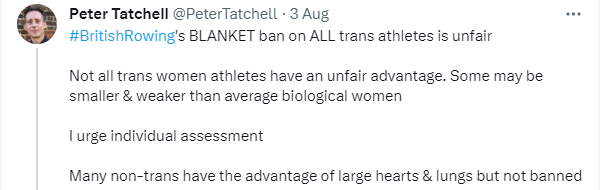
The solution was the case-by-case basis, or individual assessment. This had two variants, Everybody Out and Everybody In.
In the Everybody Out variant, transwomen were only allowed to complete providing that they weren’t good enough to win. This meant that all women’s events could only be won by women, and never transwomen. This was clearly discriminatory, so the Everybody Out method demanded that women were also only allowed to compete if they weren’t good enough to win. It followed that only those who couldn’t win could compete and anybody who won should immediately be disqualified.
The issues with the Everybody Out method became apparent during the tragic events of the 1500m freestyle for non-swimmers.
Everybody In, by contrast, allowed transwomen to compete if they were only just good enough to win. Of course, if the first transwoman to enter is only just good enough to win then the second transwoman to enter has to be only just better if they are to win, and the third only just better still. Eventually the whole field was transwomen, with the worst of them being only the barest fraction better than the best possible woman.
This seemed much fairer.
Indeed, it showed that the real question was why the hell those women were holding back transwomen by not being better themselves. If the women just tried a bit harder then the bar could be raised for the whole trans community, to allow the really elite trans athletes into sports.
It turned out, then, that if you started from the position that transwomen should be allowed to compete in women’s sport then the real question was whether it was fair to allow women to ruin it for them.
This, fortunately, was a much easier question to answer, and women were duly banned from women’s sports. A solution which suited everyone who mattered.


This was really funny, although I am not sure if it was supposed to be. Men rule The World, okay. Transgender or otherwise. I have never had a problem with men generally being physically stronger than women. It’s their brains that I have a problem with. And obviously, so do they.
LikeLiked by 1 person