Jobs for the girls

Midwifery is breaking my wife.

It’s breaking her physically, because it is a physical job and, because her NHS pension rests on it, it will keep breaking her until she’s 68, and still trying to lift patients onto beds, wading in a birthing pool or on her knees delivering a baby.

It’s breaking her mentally, because there aren’t enough staff and because responsibility is being pushed down the ranks rather than people being moved up them; senior clinical midwives are coordinating shifts, while ‘routine’ tasks are to be given to healthcare assistants.

(Fun aside: People having babies are, predominantly, young and healthy. Young and healthy bodies can, for a short while at least, compensate for things going catastrophically wrong. The gap between ‘Hmmm, this blood pressure is a little bit low’ and ‘Oh dear, this person is dead’ can be minutes. Training somebody to operate a BP machine and record the readings is like training somebody to read the fuel gauge in an aeroplane and telling them to give the pilot a shout if it says ‘Empty’)

(Less fun aside: Obstetrics is probably the only branch of medicine where a single mistake has a good chance of killing two people at the same time)

midwife
Pictured, the small part of the job where you’re not covered in other people’s goo, being sworn at, trying to keep a convicted paedophile off a postnatal ward, or having a panic attack brought on by an ambulance-chasing “Have you suffered a mismanaged birth?” advert on daytime TV

Anyway, my wife wants out, but prior to being a midwife her only real work experience was a series of admin jobs. She has a 1st class honours degree in midwifery, which is pretty vocational,  and she refuses to believe that her skills are transferable.

She gets paid less than I do, and is really just looking to match her current salary elsewhere, so to make it easy for prospective employers I’ve decided to do a side-by-side comparison of our skills…

  Me Her
Education 6 GCSE equivalents, plus a grade-4 CSE in Religious Education, can nearly speak English (Geordie, y’knaa) First class honours degree, 5 A-levels, including French
Management Skills Can look after a team of 8 people, as long as they don’t bother me too much. Sometimes we get 2 pieces of work scheduled for the same time and I have to make somebody else decide what’s more important Coordinates 11½-hour shifts of a dozen midwives, of different skill levels, plus healthcare assistants and other ancillary staff. Daily manages situations where the number of patients is greater than the number of rooms or staff available. Makes her own decisions, and decisions on behalf of others, in the knowledge that she will be held legally responsible for them. Any mistakes or misjudgements may result in death.
Dedication Pretty much a 9-5 guy (even though I finish at 5:30). Do sometimes work out of hours, if it’s important (in my opinion, not the opinion of the person shouting for the work to be done) Routinely works for 12 hours at a time, without a proper meal break. Frequently foregoes toilet breaks to get the job done. Often arrives home dehydrated, because she hasn’t even had time to have a drink of water.
People skills Not one of my strengths, but I’m quite logical, so can generally explain why things have to be done the way I say. Not good with the ‘touchy-feel’ stuff. Can sit with an 8-month pregnant mum-to-be and tell her that her baby is already dead.
Numeracy Great at this, and world-class at spreadsheets Demonstrable ability to calculate potentially lethal doses of class-A controlled substances in her head, while a woman in the worst pain of her life screams her lungs out at her. Spreadsheets nothing to write home about; ‘competent’ at best.
Coping skills Can manage when a project goes wrong, data is lost or the wrong numbers are sent to a client. Some success in turning around a potentially client-losing situations “I went into the room (to assist another midwife) and there was blood pouring off the bed. It sounded like a tap running. She’d lost 80% of her circulating volume” (nobody died, btw)
Handling responsibility Generally OK to decide things in meetings (where nobody takes the blame) Is a sign-off mentor (somebody who says trainee midwives are fit to practice). Like all midwives, she’s a primary carer, meaning she’s legally responsible for the lives and well-being of both of her patients. Works under intense pressure, knowing that everything she decides to do (or not do) may one day be scrutinised in a court of law, in far calmer circumstances, by somebody who has never had to decide which of multiple labouring women was the priority.
Miscellaneous Tinkers with IT. Manages a few data-protection questions. Writes up some policy stuff. Quite a good poof-reader Copes with women suddenly decorating her with blood, vomit, or shit, abusive partners, death, harlequin babies (if you don’t know what this means then do not Google it if you believe there is a merciful god and/or want to sleep again), delivers babies that died in-utero weeks previously, is absolutely amazing, puts up with me and all my nonsense in her spare time.

There’s a few other bits and pieces, but I think it’s pretty clear why my higher salary is justified, and she should be happy with her lot.

However, if you’re:

  1. Based in the North-East
  2. Have a decent job going
  3. Think that maybe, just maybe, some of her skills may be transferable

Then, please, let me know, because I don’t want her broken. She deserves better than a job which constantly leaves her miserable, run-down, and stressed.

If you don’t have a job to offer and if, for some crazy reason, you think that her skills are worth more than mine, that the thousands of women who are in her position deserve an employer who has their backs, deserve a properly staffed team, deserve time to eat and wee, deserve a chance to retire unbroken, and deserve the respect due to those who made sure our first seconds in this world were not our last, then talk to your MP.

Case-22

The question of trans inclusion in sport was a very difficult one, and it was difficult because the simple and clear answer, which had worked well since time immemorial, had been decided to be the wrong one.

This suggested that the question must be far more complex than it appeared to be. For this reason, people were encouraged not to ask the question at all, because they were obviously asking the wrong question.

Instead, scientific papers were written around the issue of why it was completely fair to allow transwomen to compete against women. This was a much easier question to answer, because all the scientists had to do was find data that suggested it was fair and ignore data pointing to the opposite. This is the very core of science.

Unfortunately, the ignorant masses kept choosing to believe the evidence that presented itself in front of their eyes, rather than the carefully cultivated and nurtured examples that far better educated people had chosen.

There was a brief vogue for suggesting that because, in any sporting discipline, there were some who were better than others this meant that all of sport was inherently unfair, and if some unfairness is allowed the all unfairness is fair game. Again, people who had no qualifications to their name, other than maybe having competed in some sport or other at the highest level, took the anti-philosophical view that this was a load of old horse shit.

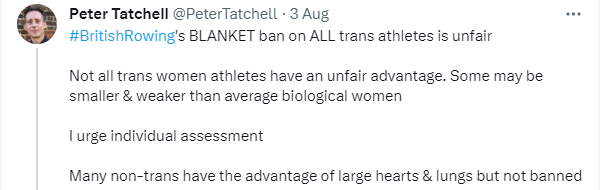
The solution was the case-by-case basis, or individual assessment. This had two variants, Everybody Out and Everybody In.

In the Everybody Out variant, transwomen were only allowed to complete providing that they weren’t good enough to win. This meant that all women’s events could only be won by women, and never transwomen. This was clearly discriminatory, so the Everybody Out method demanded that women were also only allowed to compete if they weren’t good enough to win. It followed that only those who couldn’t win could compete and anybody who won should immediately be disqualified.

The issues with the Everybody Out method became apparent during the tragic events of the 1500m freestyle for non-swimmers.

Everybody In, by contrast, allowed transwomen to compete if they were only just good enough to win. Of course, if the first transwoman to enter is only just good enough to win then the second transwoman to enter has to be only just better if they are to win, and the third only just better still. Eventually the whole field was transwomen, with the worst of them being only the barest fraction better than the best possible woman.

This seemed much fairer.

Indeed, it showed that the real question was why the hell those women were holding back transwomen by not being better themselves. If the women just tried a bit harder then the bar could be raised for the whole trans community, to allow the really elite trans athletes into sports.

It turned out, then, that if you started from the position that transwomen should be allowed to compete in women’s sport then the real question was whether it was fair to allow women to ruin it for them.

This, fortunately, was a much easier question to answer, and women were duly banned from women’s sports. A solution which suited everyone who mattered.

DID / did not

Teenagers – and I speak as one who has experience of once being a teenager, albeit just within the range of living memory – are strange, and do strange things. Many of these things are centred around rebelling, and rejecting their parents’ values. It’s hardly a surprise that this happens at the time of life when they start spending more time away from the family home, expand their social circle, and become hormone-driven to be in an in-group. As I’ve written before (In defence of gender) the latest 112 genders thing doesn’t really bother me. If their rebellion is dyeing their hair and claiming that they’re a demisexual masc-presenting non-binary rotating queeroid then let them get the fuck on with it. The correct parental response is, “That’s nice, dear. Now, what would you like for tea?”

Where it gets weird, and weirdly fascinating, is when a sub-set of these gender people claim to have a serious mental health problem.

Dissociative Identity Disorder (DID) was, until about 30 years ago, called Multiple Personality Disorder, which at least has the virtue of doing what it says on the tin. The sufferer has multiple, distinct personalities, which may be very different from the, usually passive, main identity. Stress is typically a trigger to switch between personalities, and the disorder is almost invariably linked to prolonged physical or sexual abuse in childhood. Some psychologists believe it may be a defence mechanism. The brain creates a separate person that the terrible things are happening to, allowing the victim to view the abuse as happening to someone else.

Whatever the cause, life for sufferers can be pretty dreadful. They may feel that they are watching someone else control their words and actions. Extended periods of memory loss, which sufferers typically feel compelled to deny or minimize, are one of the key symptoms. Anxiety and severe depression are common side-effects. The condition introduces enormous difficulties in terms of employment, home life, and relationships. The DSM-V reports that around 70% of diagnosed DID sufferers have attempted suicide.

Which is why TikTok has video after video of smiling teens claiming that they have DID, and doing little chats where they introduce their distinct personalities one-by-one.

Like any other teenage subculture, it has its own lingo. The personalities are called alters or headmates, the collection of them all is a system, the one currently in control is fronting. Searching for those terms on social media will bring up a load of people who really don’t sound like they’re trying to live with a debilitating mental health problem.

Now, this being the age of identity politics, it’s considered wrong to tell them that they’re lying, or at the very least mistaking something as mundane as being in a different mood with being a different personality. Nowhere demonstrates the tensions this causes more neatly than the Wikipedia page, and associated Talk page, for Dissociative Identity Disorder, which is a mess of trying to describe a real psychiatric illness, while simultaneously trying not to invalidate anyone who doesn’t actually have it, but has claimed it as their identity. It contradicts and undermines itself throughout, as it tries to present what a well-researched clinical handbook says alongside what a bunch of teenagers think will earn them social media kudos.

Where this gets interesting is when it gives us a bit more insight into a pretend sufferer than they perhaps intended.

Now, first off, this is an unsourced Reddit image that was shared on Twitter, so there’s a real possibility that everything in there is just made up. In case it’s not, let’s look at what it’s saying. This is a person claiming to suffer from DID, where their system contains multiple lesbians. One of these lesbians isn’t attracted to people born male (CAMAB = Coercively Assigned Male At Birth). Following this revelation, the poster had an argument with themselves, got that part of their personality to say they were sorry, but doesn’t know how to make that part fancy men who present as women, as is properly ordained for a lesbian.

Leaving aside the “It’s all made up” explanation, there are 3 others:

  1. The original poster made this up to get attention. This is quite likely, after all they’re pretending to have a serious mental-health problem to get attention.
  2. The poster is a man, and is making up an excuse why they won’t be having any sex with lesbians who aren’t actual women, thank you.
  3. The poster is actually a lesbian and is trying to ask a real question in a way that won’t get her flamed to hell and back. She’s been taught to believe that transwomen are women, and is happy to say that’s the case in most situations (which is why the other lesbians in her system are cool with it), but just can’t bring herself to actually fancy them, because sexual orientation isn’t a choice.

Through the prism of possibility 3, it’s a desperately sad story. A young women doesn’t want to have sex with men, but is arguing with herself, and asking for help in the most submissive way possible, in order to try to perform conversion therapy on herself. In effect, DID – albeit faked DID – is her defence mechanism. It’s not her having these terrible thoughts about not seeing transwomen as women, it’s removed to one of her headmates. The cognitive clash between what she wants to believe and what she actually knows to be true has become an internal argument, that she doesn’t know how to resolve.

And that’s where, “That’s nice, dear,” is inadequate, because it can’t be healthy to live like that.

The Interview…

Act I – In an office. I can’t be bothered to described it. Just imagine a bloody office. Dave is greeting Anteros, who’s there for a job interview.

Dave: Good morning, Anteros, thanks for coming in today. Take a seat.

Anteros: Morning.

Dave: Now, just a little about how this interview is going to go. We like to keep it all fairly informal, so we’ll just be chatting about you, about the jo…

Anteros: I’m asexual

Dave: Sorry?

Anteros: I don’t feel sexual attraction.

Dave: Okaaaay, that’s probably a bit more informal than I had in mind. We’ll be talking about what you have to offer the company and what…

Anteros: It’s legal for you to discriminate against me.

Dave: What?

Anteros: You can refuse to give me the job and say it’s because I don’t feel sexual attraction. That’s completely legal.

Dave: Right, well that’s not one of the criteria we’re using to judge applicants, so let’s not worry too much about that, eh?

Anteros: Are you saying you don’t discriminate against asexuals?

Dave: No, why would we?

Anteros: Right, then how many asexuals do you currently have working for you?

Dave: I have no idea. That isn’t the kind of thing we ask staff here.

Anteros: So you don’t even do basic equality monitoring. You don’t know how many people you employ are ace-spectrum?

Dave: Sorry, what spectrum?

Anteros [sighing]: Ace-spectrum. Asexuals, aromantics, agender folx, demisexuals, semisexuals, apogender, double-non-binary…

Dave: Ah, we monitor the number of non-binary employees as part of our DEI, and our latest report shows…

Anteros [getting angry]: Not ‘non-binary’, you bigot, ‘double-non-binary’… Those of us who reject the concept of there being a non-binary slash binary binary to be non-binary from.

Dave: I’m sorry, what?

Anteros: It’s all a spectrum. A beautiful spectrum.

Dave: Right. Well. Moving on with the interview…

Anteros: What’s the point, when you’re so obviously biased against aces?

Dave: Biased against them? I didn’t know they were a thing until two minutes ago!

Anteros: Yes, because you didn’t put in the emotional labour to educate yourself. You waited and demanded I do it instead. Classic bigot behaviour!

Dave: Come on, be fair, how was I supposed to educate myself about something I didn’t… no, no, forget it. We’re losing sight of our purpose here. Let’s get back to the interview. Tell me a bit about yourself.

Anteros: Well, I’m asexual.

Dave: Yes, I got that. Can you tell me something else about yourself? Where are you working at the moment?

Anteros: Obviously I’m not working, because of the shocking bias against asexuals. Which isn’t even illegal!

Dave: Yes, you already said, but can we please talk about the job?

Anteros: How can I talk about anything else, when somebody could force me into conversion therapy at any time?

Dave: You’re worried that someone is going to try to convert you to wanting sex?

Anteros: Of course!

Dave: Has anybody ever tried?

Anteros: Not so far, no. [Beat] But they could!

Dave: I can see why you’re worried.

Anteros [not noticing the sarcasm]: Plus there’s the constant pressure society applies to have a partner, have kids, respond to sexual stimuli. We’re bombarded with sexualised imagery. It’s probably turned millions of asexuals into prosexuals [beat] against their will. Maybe you were one of them. You might have been born asexual and then converted!

Dave: Well, yes, I do remember getting convert to sexuality. Mainly between the ages of 13 and 18.

Anteros: Yes! You see? Forced conversion has ruined your life!

Dave: It really hasn’t. I’ve been happily married for 20 years.

Anteros: Twenty years? Well why didn’t you say so? You sound like just the kind of person the not-interested-in-sex movement is looking for! Let me tell you about the benefits. We’ve got a flag, and there’s marches, and activism meetings…

[Play full-time whistle, audience goes wild, tears are shed, everyone vows never to have sex again]

A few good men

With violence against women having taken a bit of a sharp upturn over the last 10,000 years or so, it seems to me that it’s about time men started doing something about it. By this I mean a bit more than the helpful advice we’ve given them so far, such as not dressing provocatively, not going out alone, not going out at night, not drinking too much, not talking to strangers, not ignoring strangers, not laughing at us, not flirting if they’re not going to follow through, and, for god’s sake, to smile once in while. I’m not quite sure what the problem is, but for some reason none of that seems to have stopped men hurting them. Maybe they’re doing it wrong.

No, we need something that more actively involves men. I had a good old session thinking about it, and somewhere about the half-way mark on the fifth pint an idea came to me. What if we had some men who were known to be Good™. Men who could be trusted. Men who wouldn’t be abusive. Men who women could trust and turn to if they were in need. I’ve been hearing for ages that it’s not all men, so there must be load of these Good™ ones around.

Obviously, for these men to be placed in a special place of trust there’d have to be a lot of safeguarding in place. There’d have to be background checks, sworn testimonies from people who knew them, a lengthy and demonstrable record of doing the right thing, something to identify them, such as cards or maybe a uniform.

Then I though that all sounded a bit fash, so I scrapped the lot of it and decided just to let each individual man decide whether he was Good™ or not. Honestly, it cuts out loads of paperwork and it seems unlikely that more than a handful of men would ever lie about being Good™. Why would they need to? It’s not like men have needed to claim to be Good™ in the past in order to do bad things.

“You want the truth?”

I did briefly wonder if we needed some way to take away this saintly, trusted, Good™ status from men who misbehaved in some way. I mean, supposing a man murdered a woman – which women are really opposed to – should he still be able to declare himself Good™? Initially this seemed like a no-brainer, but then I thought of lots of other things. That those men may still see themselves as Good™, or genuinely want to be Good™, or that maybe it was discriminatory to use past behaviour to predict future Goodness™, and that it might involve more paperwork for me somewhere. Then I decided it was probably best just to let them change their name or something and carry on being Good­™.

All in all, then, I think I’ve come up with a pretty watertight scheme. Women worried about accepting a drink from a stranger, or a lift, or about the man walking behind them at night, or wandering into their changing rooms, to check everyone is OK, can now just simply ask if he’s Good™ and know that they can absolutely trust his answer and relax, because it’s only Bad® men who’d ever hurt them.

And if you think you’ve spotted any loopholes in my scheme then just remember, the majority of Guardian and Observer journalists agree with me!

Trust me, I’m Good™

I’m every woman (p<0.05)

You don’t have to traverse the highways of the Twitter [debate / argument / slanging match] (delete as applicable) for long before someone with a beard will tell you that most women support trans rights. They might further tell you that women are more supportive than men, undermining the argument that the people who claim to be speaking out for women’s rights are doing so on behalf of women. Just the other day somebody was claiming that those who oppose trans rights trampling all over women’s right were a small minority of bigots.

Sometimes, your new beardy friend will have some stats to back up these claims. Let’s have a look at some statistics.

Mel Gibson in What Women Want (2000, dir. Nancy ‘Russ’ Meyers )

The survey I’m using here is a year old, so well before the current argument about someone who almost everyone agrees is man was in the news for being, to take the minority views, either a woman or a rapist. The figures presented come from the Savanta poll on behalf of BBC Scotland, which was published in February 2022.

I’m using this survey because, for me, it’s pretty close to being the gold standard on how to poll on this issue. The terms are very clearly defined, the survey asks specific questions and then digs into the detail a little more. While it polled only in Scotland, the base size (2,038 respondents) is good, and enough to put the margin of error within ±2%.

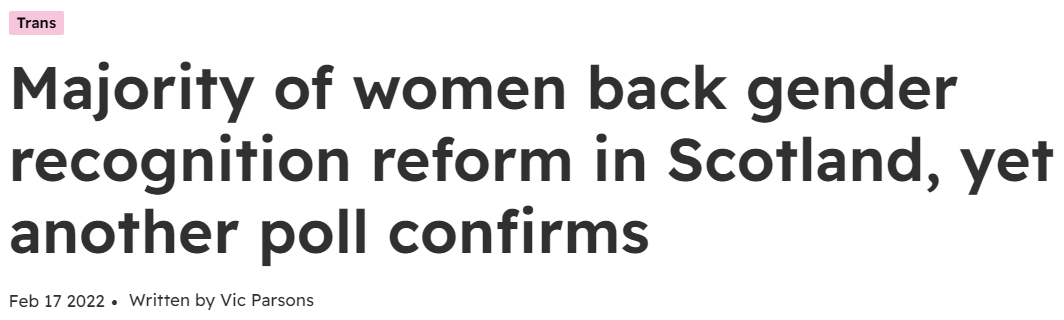
Firstly, the headline figure, which was reported by Pink News at the time the survey was published.

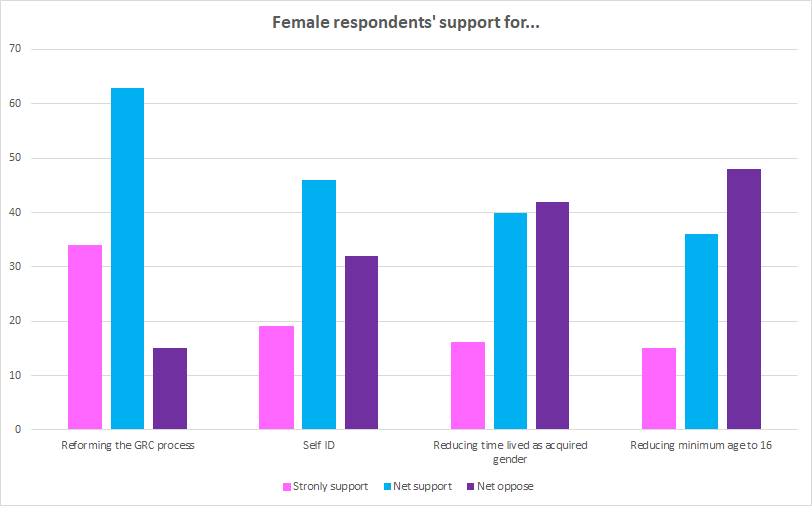
The headline is absolutely correct. Asked, “Given this information on the previous pages, to what extent, if at all, would you support or oppose making the process to acquire a Gender Recognition Certificate (GRC) easier for transgender individuals,” 63% of women expressed support, with only 15% opposing (the remainder said they had no opinion or didn’t know). Further, with 34% of women saying that they strongly supported reform, while only 5% said they strongly opposed it, the case for it only being a small minority of women who complain about trans rights seems to be true.

However, I picked this survey because, as noted, it digs into the detail a bit deeper… and that’s where things become interesting. The plans of the Scottish Government at the time, since introduced in their Gender Recognition Reform Bill, to make it easier to obtain a GRC were based on three key changes:

  1. Removing the need for a medical diagnosis of gender dysphoria ( a measure commonly called ‘self ID’)
  2. Reduce the time applicants need to have lived in their acquired gender prior to being granted a GRC, from 2 years to 6 months.
  3. Reducing the minimum age an applicant can apply for a GRC from 18 to 16

The Savanta survey, bless it, asked about all three of these measures in follow-up questions. On the first point, self ID, only a plurality of women (46%) supported the measure, not a majority. Strong support had dropped to fewer than 1 in 5 (19%), while strong opposition had tripled to 15%.

What is truly surprising, given how much debate time is given over to the pitfalls of self ID, is that this was, with women, the most popular of the three reforms.

Reducing the period living as your acquired gender saw more women (42%) opposing than supporting (40%), with only 16% of women strongly supporting the change – only half of those who said they strongly supported reform overall. Reducing the age limit was even less popular, with 48% of female respondents opposing it, 28% of them saying they strongly opposed it (compared to 15% strongly supporting the change).

The Pink News headline, then, seems to have rather overstated the case. While a healthy majority of women did support reforming the gender recognition process, they gave majority support to none of the measures to do so, and for two of the three proposed measures opposition outweighed support.

Following questions asked about transwomen’s access to different areas of female life – toilets/changing rooms, amateur sports, elite sports, and domestic abuse services. The results are shown below, reordered to show from most supported to least.

Again, we only have one area where there is majority support, although more support than oppose everywhere but in elite sports. However, in 4 of the 5 areas we see 20% or more of the female population opposing trans inclusion. This is not a tiny minority that we’re talking about.

Toilets/changing rooms are presented differently in that graph because, while the rest of the questions were asked on a Strongly Support through to Strongly Oppose scale, respondents were only given a should/should not option on whether transwomen should use women’s toilets.

Fortunately, thanks to the fickle gods of questionnaire design, all respondents were asked a follow-up question about the circumstances under which transwomen should be allowed to access women’s toilets and changing rooms, with the options of three levels of transition – roughly, social, legal, and surgical – and a ‘Never’ option.

Only 17% of women said that transwomen should have access to these spaces if they haven’t legally or surgically changed their sex. A similar number, taking the total to a third of all women, were prepared to extend access to those who had legally changed their gender, but hadn’t had any surgery, and another third of women were prepared to let those who had surgically transitioned enter.

Looking just at the women who were prepared to allow transwomen into their toilets, the split between those who would do so without surgery and those who saw it as a prerequisite is almost perfectly 50/50 (354 respondents in favour of access without surgery vs 352 who said it should be a requirement).

What’s interesting (well, to me, at least) is that none of those numbers really align with the 45% figure for women who said that transwomen should be allowed to use such spaces in the earlier question. Making the question more detailed showed that, offered a more nuanced option than all or none, some women who said that transwomen should be allowed in made it clear this was only after surgical transition. We can only guess at how sports, prisons and domestic abuse services would have fared if they’d been asked about in the same level of detail.

What we undoubtedly see is that around 1 in 6 women strongly support trans rights. Figures within the margin of error of that number appear in the ‘Strongly support’ category throughout the survey. Without a breakdown by age within sex it’s impossible to be sure, but the correlation of strong support with the younger age group likely means that these are predominantly young women.

Other than that, women seem resistant to the idea of blanket allow/don’t allow rules in many areas of life, but the more detailed toilets/changing rooms question suggests that this is because they recognise a meaningful difference between those who have undergone a lengthy and difficult process to transition, and those who have simply socially transitioned. This would tie in well with them being less willing to support making the GRC process shorter.

That elite sport is the bridge too far, the point where those opposing trans inclusion shift to being the plurality opinion, is also telling, as this is also the point where even surgical intervention would not level the playing field (see what I did there?)

These two questions between them suggest that it’s a common view not everybody who says they’re a woman should be treated as one, and that there should be limits to the circumstances in which they are treated as such.

Of course, when you ask 1,110 women for their opinion you’re very unlikely to get a single, unified answer, but if there is one here I’d say it’s this…

You’re right, Mr Beard, more women support transwomen’s rights than oppose them.

They just, when you get into the details, don’t agree with you that transwoman are women.

Hogwarts Legacy – A review

Let me start by saying I have no choice but to review this game. I have literally no agency in the decision to write this review. None at all. I’m like one of those soldiers who had to only obey orders. Actually, nobody has even ordered me to write this. That’s how subtle the control the forces of darkness wield are. Even though nobody would notice or care if I didn’t write this review and I could, literally, stop writing at any time, the decision is somehow completely out of my hands. Please don’t blame me for this.

Now that we’ve got that out of the way, I’d like to spend the next 6 paragraphs talking about Lembit Opik. This may puzzle you, as Opik wasn’t involved in any way with the production of this game, but he does look like what would happen if Harry Potter found out at the age of 11 he was really an accountant, and I’ve been nursing a grievance against him for three decades, so here – in this review that you’re reading to find out if the game is any good or not – is the best place to air it. Right, here we go…

[The following paragraphs have been cut on the advice of my, and several other people’s, lawyers]

Four-eyed git.

Straight off the bat I’m giving the game 0/10 for including Harry Potter. That’s right, the game set in Hogwarts does even include Hogwarts’ most famous student. In fact, I think it all happens years before the events of the books. It’s hard to be sure, though, because every time somebody starts explaining something to you a little prompt, reading “Skip”, appears in the corner of the screen, and I thought that was an instruction.

This means that the plot, as far as I can work out, is skip, skip, skip, and then suddenly fighting a statue, alongside an older gentleman. I assume that this is some sort of metaphor that Opik, who didn’t write the plot, has worked in. It’s so obscure I can’t work out what it means, but it’s doubtless racist and probably homophobic. That’ll be 0/10 for plot as well, then.

I should add that not only is Harry Potter not in this game, but you have to do the work of deciding who is. You literally have to think of your own character name, decide what they look like – right down to their hairstyle – and even choose whether they sleep in the wizard or witches’ dormitory. Now, in the last game I purchased (Doom II) the game designers weren’t too busy being hateful to find time to do all of this stuff for you, and that’s how things should be, so 0/10 for design.

On the other hand, I panicked and accidentally gave myself a man-bun and, shortly thereafter, was sorted into Slytherin House, so a reluctant 9/10 for continuity.

Of course, once you actually get sorted, and get to wander around Hogwarts, the problems really start. First off, the place is massive, with all stairs and corridors and secret passageways and rooms and shit. Then you discover there are loads of outside locations as well (Why wasn’t this game called Hogwarts and Environ Legacy, eh – 0/10 for accurate naming!). Honestly, nobody has got time for all this shit.

And you will need a lot of time. It seems that, in their twisted ‘wisdom’, the developers – no doubt guided by Lembit Opik – have decided to move away from the traditional ‘Z’ for left, ‘X’ for right, space-bar to fire controls. Getting around now involves two joysticks and about 16 buttons, often using two of them at the same time! I can only assume this game was designed for the booming market of octopuses suffering from polydactylism. A well deserved 0/10 for controls it is.

Finally, the graphics. I must admit that, in places, they looked quite stunning. Not much good to me, though, because I’ve spent three days walking into a wall, trying to find out which of these damn buttons you press to go left. To take the least charitable interpretation, which I must while Opik is living rent-free inside my skull, they probably just hired good graph people to do a couple of scenes and a bit of wall texture, and the rest is shite. Other games are probably much better. No, I’m not saying which ones. Go on, then, 1/10 for graphics. But only because that wall texture is quite realistic.

I did let my 13 year-old son play the game and he thought it was brilliant, but he was doing stuff like casting spells, riding a broomstick, and defeating 30-foot tall monsters, none of which I saw, so the little shit had probably sold my copy (which I hadn’t paid for, honestly) and bought a different game instead.

In summary, then…

Including Harry Potter0/10
Plot0/10
Design0/10
Continuity9/10
Accurate Naming0/10
Lembit Opik0/10
Controls0/10
Graphics1/10
Honesty of 13 year old son0/10
Enabling me to deal with differences of opinion in an adult fashion0/10
TOTAL10%

Final Verdict: I hope that I have satisfied you that I am properly in your cult, even though I have played this game. Please don’t hate me for running into a wall for 3 days, I HAD NO CHOICE!

At the Edinbru GRC office

Scotland, pictured tomorrow

Officer: Good morning, sir, how can I help you?

Visitor: Miss, actually. I’m a woman.

Officer: Sorry, si…miss, of course you are. Please forgive my slip of the tongue. Your beard threw me off recognising your true femininity.

Visitor: Aye, smashing.

Officer: Anyway, miss, how can I help you?

Visitor: I’m here to register for a gender recognition certificate.

Officer: Excellent. A brave and stunning choice, if I may say so. Now, you are aware that you have to provide evidence that you’ve been living as a woman for three months or longer?

Visitor: Yes. I’ve been doing that.

Officer: Excellent. Can you give me some examples? For the form.

Visitor: Well, I’ve been spending a lot of time in the women’s changing rooms at the gym.

Officer: Ah, I guessed that you worked out a lot, from the way you so completely fill that charming XXXL “Show me your tits” t-shirt. Now, do you always use female pronouns?

Visitor: Yes, I call everyone ‘Babe’, ‘Sweetie’, or ‘Sugar-tits’

Officer: Good, good. And how about things like your driving licence and bank account? Have you informed them that you’re female?

Visitor: Not yet, because I’m not ‘out’ to my wife. She’s had a lot of problems accepting that I’m just trying to find lesbian love, and she says she’s taking the kids if she catches me at it again.

Officer: Tsk, women, eh?

Visitor: Ahem!

Officer: Oh, not you, sir. I mean those other women. The bad kind.

Visitor: Um, when I get me GRC I’ll be able to call them bigots and have them hounded out of their jobs, right?

Officer: Absolutely, sir and miss, all part of the service. Right, now you have to make a solemn declaration. I need to warn you that it’s a criminal offence to make a false or fraudulent declaration.

Visitor: There’s not a lie-detector test or nothing, is there?

Officer: Hahaha, of course not, smiss, you just sign here, to indicate that you understand it’s an offence to lie to us, and that you really, truly are a woman, and then we believe you.

Visitor: And I don’t have to get me knob cut off, or anything like that?

Officer: No, that would be barbaric. It’s no indication that you’re not a woman.

Visitor: So… what kind of thing would make you think I was lying to you?

Officer: I’ve no idea, missir it’s never come up.

Visitor: OK, well that’s not a problem, then.

Officer: Thank you. Lovely signature. Very girly the way you’ve drawn hearts over your X

Visitor: When do I get my certificate, then?

Officer: Hold your horses, young lady, I need to ask if you’ve been convicted of any sexual offences.

Visitor: Well, you know, one or two… but not for weeks now.

Officer: Sorry, but that means I have to make enhanced checks. Now, are you really, really sure you’re a woman?

Visitor: Yes

Officer: Good, good, that all seems to be in order, then.

Visitor: Hang on, if I want to change back to being a bloke I can, right?

Officer: Yes, of course, you just have to make another solemn declaration that you plan to live the rest of your life as a man.

Visitor: And I wouldn’t get done for that fraudulent declaration thing?

Officer: No, no, because gender is a fluid and evolving inner sense, which can change for many reasons over a person’s lifetime, and as long as you are being truthful at each declaration then you’ve nothing to fear.

Visitor: And it wouldn’t matter how long there was between these solemn declaration?

Officer: I don’t think so, but how long are we talking about?

Visitor: Well, next week… if I get acquitted.

Mammoth Migration

With the more-reported-than-so-far-happening death of Twitter, Mastodon has emerged as the destination of choice for those seeking a Twitter-like experience. There have been many tweets and articles describing how Mastodon is different to Twitter, but in a nutshell…

…shared data protocol.

Sorry, I waffled on for a bit there, didn’t I? I don’t blame you if you zoned out. The key point is that Twitter is one big thing, Mastodon is lots of small things joined together.

In some ways, having one big thing is bad. Some idiot could buy it and run it into the ground, for example. With the lots-of-small-things model the same idiot could pay around twenty bucks a month to run his own small-thing, and do what he liked with it, making a saving of $43,999,999,980.00 in the process. Except he couldn’t. For the small things to work in a way that emulates the one-big-thing all the small-things have to agree to talk to each other and Mastodon has an explicit “Be nice” spirit, which seems to place it one Kerplunk! stick away from descending into a purity-spiral so deep that it might bore a hole to the centre of the Earth.

For example, lots of people have been gleefully sharing this conversation with Eugen Rochko, the founder of Mastodon, as a great example of how the platform will be better than Twitter, seemingly without pausing to ask themselves, “Who’s deciding who is a Nazi?”

The lots-of-little-things model means everything is in the hands of lots-of-little-moderators. If one of moderators on the little-thing your account is attached to decides you’re a Nazi – perhaps for saying that women are real – then that can be it; your whole account, all your posts, all your follows and followers, gone. And your ban might not even be for saying anything. Maybe you just posted some links to news stories that suggest you’re guilty of wrongthink, or retweet someone who’s saying the wrong thing, or just have already upset enough people that they badger your local moderators to not even give you a chance, as was the case with Telegraph journalist, Suzanne Moore.

The lots-of-little-things model means its lots-of-little-moderators are all weak links, even ones not swigging the gender ideology Kool-aid, likely to be easily swayed by mass reporting, or hearsay about who’s too dangerous to let on to Mastodon.

Nor is there a loophole in getting a few people together and setting up your own little-thing. When a group of gender-critical people tried that in in 2019, with Spinster, the moderators of other little-things were pressured into not talking to it, which has a special Mastodon name that’s too boring to repeat. In other words, you’re free to moderate your own little-thing, so long as you don’t mind only talking to other people who use that little-thing and having nothing to do with the lots-of-little-things-joined-up-to-look-like-a-big-thing thing.

All of this happens with no oversight and no recourse. The moderators are the lords of their own little-things, and can ban users and silence other little-things on their whim. The one-big-thing’s moderation system was arcane, heavily skewed towards the tech-bro mentality, and was a complete black-box, but at least there was a box.

By now a load of Mastodon fans have skipped to the comments section, to tell me that this is all a feature, not a bug, and that they like it this way. I’ve even seen a few people say that the Mastodon experience reminds them of the web forums of the 90s and early 2000s, and say that as if it’s a good thing.

We seem to have collectively forgotten what horrible, insular, clique-driven, boys’ clubs they were. Women were welcome, of course, so long as they were gamer chicks, or biker chicks, or nerd chicks, or cool chicks, who’d laugh off (or oblige) the ubiquitous ‘TOGTFO’ comments, and be the kind of chick who wouldn’t complain she’d just been called ‘chick’ five times in quick succession. And so many of those forums were convinced they were “nice” places, because they were run on ‘Just be nice’ rules, where the people enforcing the rules decided what was nice.

Mastodon, though, really seems to go the extra mile in adding a layer of earnest humourlessness on to the top. There’s a “We’re all mad here, us,” energy to the humour that does slip through, followed by a reminder that some neurodivergent people can’t immediately recognise humour, so all jokes should have embedded humour tags, so as not to exclude them, and should link to an essay explaining the joke.

What the last few years on Twitter have taught me is that for the men’s-rights movement that hides behind the trans colours to succeed it needs people not to talk about it. It needs women with strong voices silenced. It needs po-faced acceptance of the absurdities it insists are truths. In Mastodon it seems to have found its perfect partner.

I think Musk is an idiot, but with Twitter on life-support, I find myself hoping that he’ll back away from his huge, unforced errors, and let it recover. The alternative is [Account Suspended].

War identifies as hell

The 1970s film from Doris Wishman (not a transman suffering from nominative determinism, but a pioneer of titillating nudist films), which features graphic scenes of a man undergoing sex change surgery, begs in its title Let Me Die A Woman!

The US Selective Service System – the draft board, to you and I – has considered this and decided, “Fine. Die how you like. It’s the dying that’s the important bit,” and has announced that those born male must register for potential selection, even if they now identify as female. In a single decision they have managed to upset both trans activists, annoyed that pretending that identity is real thing stops abruptly when war looms, and the gender critical, annoyed that the pretending identity is a real thing was allowed to sweep over women’s rights and spaces and only stopped at the edge of the traditionally male-dominated arena of blowing the living shit out of each other.

The army, making a man of men, against their will, since forever

Given that getting those two groups to (sort of) agree on anything is nigh on impossible it seems that doing so should qualify for a Nobel Peace Prize, which is rarely awarded to those trying to staff up a shooting war.

The issue that the Selective Service people have is that they fear that, when asked to go and face a hail of Russian bullets, a large number of men may suddenly decide that they are, in fact, ladies… for truly it is said that there are no gender atheists in a folx hole.

The follow up question, that everyone on the government side is now desperately trying to avoid, is whether it can possibly be the case that men would only pretend to be women for this one specific reason. Given men’s long history of being willing to risk ridicule, social exclusion, prison, actual death, and injuries that would make a grizzled SAS soldier throw-up, just to get sexual thrills, especially from women who don’t want to grant them said thrills, it seems unlikely that only the theatre of war is a stage they won’t tread on.

Furthermore, if we won’t take men’s word for it that they’re women when it comes to drawing a rifle, why are we willing to do so when they’re rifling through drawers in a Primark changing room? One of the foundational lies, which has been taken at womanface value by so many governments, is that nobody would ever pretend to be transgender, yet here’s the admission that, yes, they clearly would. And not just for something trivial, like voyeuristic thrills in communal changing areas, or having unlimited access to women who can’t leave in prison, but actually for something as base as not wanting to act as temporary lead storage facilities for their country. After that, how does a government go back to claiming that transwomen are women with a straight face?

To further confuse matters, trans-rights activists have recently taken to accusing those who are gender critical of being aligned with Putin, because they agree with him that men cannot become women. If the service providing the American infantry is also pulling back from acknowledging gender fantasy does that mean both sides are aligned with Putin? I’m no military expert, but I think one of the fundamental prerequisites for a war is that some of the players must be fighting for the other side.

It certainly couldn’t be something like agreeing on absolute literal reality not being a reliable indicator of agreement on all issues, because that’s too complicated to fit into a simple chant.

While we wait to see what happens to the transwomen – who are women – who are forced to sign up, because they’re not women, and the transmen – who are men – who aren’t allowed to sign up, because they’re not men, and also whether the world will end in nuclear fire, we can at least amuse ourselves at this sudden and unexpected rally against inclusion, this draft excluder.