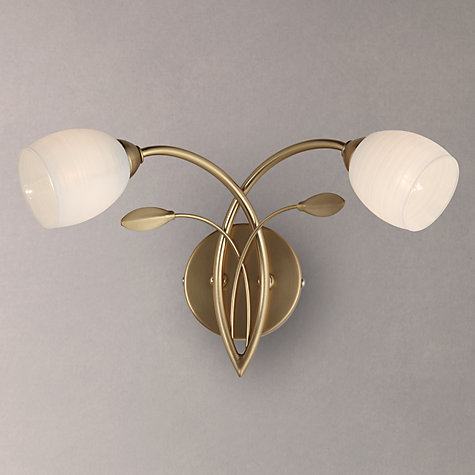
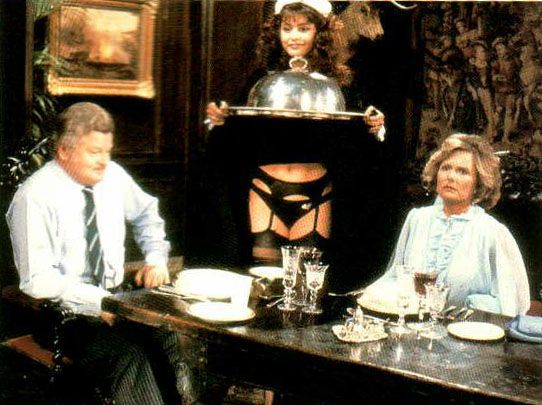
In fairness my wife didn’t give me any context, she simply stuck her phone between my face and Westworld and asked, “How about these?”
Even the smallest of clues, “What do you think of these wall-lights?”, for example, might have solicited a more appropriate response…”They’re lovely and if they’re what you want providing light then we should absolutely get them.”
But she didn’t, so I answered “Ovaries”. She wasn’t thrilled. I told her we should get them anyway, but she was unconvinced. Now all she could see was ovaries. Being a midwife I imagine she gets enough of that at work.
Eventually our daughter was summoned downstairs and told to give her first reaction to the picture she was about to see.
Despite my wife’s later protestations and sulking there was no collusion, my daughter looked at the picture and immediately said “Ovaries?”
We held a referendum in my house earlier this year, on the subject of “Should this house have a conservatory added to it?”
My wife led the ‘Yes’ campaign and I was swayed by her promise that the new part of the building would have sufficient space for me to have a proper computer desk again (since my ‘study’, colloquially known as ‘the pit’, was converted to a bedroom, eight years ago, I’ve been stuck on a tiny table in the corner of the dining room).
A major company specialising in such things came to visit, showed us nice brochures, sucked their teeth a bit and then offered us a quote that would have left us with a lovely conservatory, but also 10 or so years on an enforced diet while we were unable to afford food.
Our conservatory, pictured yesterday in 1851
A second, local, company came out and also sucked their teeth a bit, before giving us a quote that was within our budget. Unfortunately before they’d got as far as drawing up the plans they realised they’d forgotten to properly cost for the foundations and that they needed an additional 5-figure sum from us to correct that oversight; assuming we didn’t want the whole thing to detach from our house and slide down the hill before crashing spectacularly into our neighbour’s home.
My wife and I have no experience of conservatories. I doubt I could put up a garden wall, let alone a structural extension to the house, so we’re in a poor position to argue costs with these “…and there’s a special manager’s discount if you pay a 15% deposit today” merchants. This was their stock in trade, whereas between us we’ve purchased exactly zero conservatories, extensions or orangeries.
Our options then were:
Pay a ruinously high price and get the conservatory we dreamed of…briefly, before the bank repossessed it and the house attached to it.
Get a much smaller, more affordable, conservatory. Unfortunately this would leave me without a desk space while still spending tens of thousands of pounds that I might prefer to spend on, say, getting rid of my hated old car.
Keep getting quotes for conservatories, with the possibility that there may be an unbridgeable gulf between what we want and what we’re prepared to pay for it.
Decide that the whole thing was a bad idea and re-think our options from scratch.
Funnily enough it seems that there’s a body of people who think that even discussing the possibility of the 4th option is an outrage. As the proposal to build was passed with an unprecedented 100% majority a conservatory must be built. To hell with the cost, or, if the cost really is an insurmountable problem, then we must have something that’s not suitable for the purpose for which it was intended, because above all else there must be a conservatory. If all we can realistically achieve is getting a builder to knock out the back wall of the house and glue a caravan awning in place then that’s what we must do, because that’s what people voted for.
It almost seems like an analogy for something, but exactly what escapes me.
Just short of two years ago I had my most memorable conversation with my son, currently 7, as we sat in a petrol station, waiting for my wife to pay for the fuel she’d just put in the car.
“Dad,” asked his voice from the darkness of the back seat, “Do you believe in Jesus?”
At the time he had a very religious substitute teacher taking his class and there’d been a lot of talk at home of biblical issues, so the question wasn’t completely out of the blue. I’m an atheist, but I’m also keen not to force my views onto my children, so I gave a considered answer.
“Well I believe that Jesus existed and was a real person, but I don’t believe he was the son of God. A lot of people do believe that, though.”
“I believe that.” he informed me.
“If that’s what you believe then that’s fine.”
There was maybe thirty seconds of silence from the back seat (an exceedingly rare event with my son), then he clinched the argument.
“I think it must be true, because the book about Jesus was in the non-fiction part of the library.”
Atheism be damned, I’m not going to tell my child that librarians aren’t infallible and all-knowing.
“Let us all Neil in prayer”
I mention this story as an illustration of something that every parent knows; that children are sponges for knowledge. They soak up what happens around them and learn it, but critical analysis of it is limited.
This is why, for example, you probably learned the story of the birth of Jesus when you were at school and haven’t really thought about it since, and so not realised that none of it makes any damn sense at all (I did blog about what’s wrong with it some time ago).
This thirst for knowledge, coupled with an inability to weigh the truthfulness of that knowledge, is what makes anything involving children and politics such a red flag. Especially when, as in the case of Momentum Kids – the new childcare organisation, attached to the Momentum political group, that aims to help parents get involved in politics by taking their kids off their hands – it’s announced like this:
Political education first, childcare second
Less than 12 hours after the announcement Momentum are already spinning criticism of it as the work of the ‘biased’ MSM, or sexists who are opposing women being involved in politics rather than staying at home with the kids. In their defence, comparisons with the Hitler Youth are crass, but largely the people complaining are those who’d also, rightly, complain if the Conservative Party started a nationwide chain of crèches (Theresa’s Toddlers, perhaps) or if the Britain First school opened its doors to ‘selected’ children.
However benign a political organisation’s intentions are once they intersect with children thoughts automatically turn to indoctrination. When the organisation is already having difficulty shaking off allegations of abuse, bullying, sexism and anti-Semitism, as well as fighting a well-documented battle with the forces of reality, it’s a disaster.
Journalist Owen Jones has published a long blog today, asking Labour supporters to unite behind Jeremy Corbyn when he wins the leadership contest. In it, as well as laying out a media strategy that could have been dreamed up by somebody who’s watched The West Wing, but which he’s having to explain to a group who’ve been in control of a major political party for a year, he argues that Corbyn’s media gaffs are getting less frequent. Yet Corbyn is shackled to Momentum, an organisation so lacking in nuance that they can’t even recognise how toxic their brand is and avoid coupling it to such a sensitive issue as childcare.
As we’ve seen again and again over the last dreadful year the bubble of worth in a policy is encased in leaden delivery before being tossed into the sea of public opinion to see if it floats. So rather than seeing an organisation making a genuine effort to make politics (albeit just its politics) more accessible we get visions of Parsons from 1984 being denounced by his own children, or the famous Jesuit maxim about giving them a child for the first seven years of its life.
Which, I suppose, brings us back to the question of belief. However sincerely Momentum intend to deliver a balanced political education for child I suspect too few will be willing to file their claims in the non-fiction section of the library.
My mother, being from a good Catholic Irish family, tried her level best to raise me and my brother into the faith, despite my father’s unspoken atheism.
“Mum, why does Dad never come to church with us?”
“Because he belongs to a different religion, one that doesn’t go to church very often.”
My Dad’s religion certainly seemed better, especially during those long, toy-free, Christmas morning masses.
None the less, aged around 10, I started going to classes to prepare for my first communion. If you’re not familiar with Catholicism then communion is when you eat the little circular wafer that, thanks to the magic of transubstantiation, becomes the body of Christ.
I mention all of this because the nuns who were preparing me for my first communion were very keen to describe how it should only be taken in sin-free state. This meant having my first confession, telling a priest my sins and having them absolved. I was fascinated by this.
“What happens if a priest commits a sin?”
“They make their confession to another priest, who absolves them.”
“What happens if the Pope commits a sin?”
“Then the Holy Father will make a confession to a priest or a bishop, and they’ll absolve him.”
“What happens if Jesus commits a sin?”
“Jesus can’t commit a sin.”
“Why not? What if he did? Who would he confess to?”
“Go and stand in the corridor!”
I don’t know how much my parents paid for my first communion lessons, but they should be aware that between this and “Why didn’t God just give the dinosaurs souls?” I spent a lot of it just standing in corridors, thinking about what I’d done.
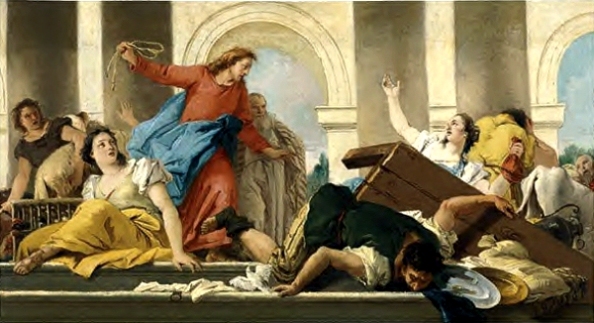
The Jesus one bothered me…surely Jesus had committed a sin. Hadn’t he been angry at the money-changers in the temple, and wasn’t anger a sin? The nuns seemed to think that most things were a sin, including the mysterious “impure thoughts” that they were reluctant to elaborate on (more corridor time for me). It worried at my soul that an organisation should be in such reverence of someone that they are incapable of acknowledging that they could ever do wrong.
Using you skill and judgement mark an ‘X’ on this picture where you think the sin is.
Which, via a 350 word roundabout way, brings me to the Labour party.
Some years ago I complained on Facebook that Tony Blair’s Labour was really a continuation of the Tory party. One of my friends corrected me, and reeled off facts and figures in the way that John McTernan does these days…and he was right. I read what he wrote and realised I was being an idiot, parroting opinions I’d heard without really subjecting them to any analysis. As an opinionated, arrogant, egotistical sonuvabitch I admit I’m wrong few enough times for them to stand out in my memory.
A few weeks ago the same Facebook friend told me that if we’d listened to Corbyn’s peace plan for Northern Ireland then hundreds of lives would have been saved.
I don’t think I can find the words to say how much that one post upset me. Somebody who I’d regarded as learned and wise was deflecting Corbyn’s support for the IRA; not by minimising it, or passing it off as a media smear, but actually by saying that it was the right thing to do. We should have utterly capitulated to those inflicting terror, because doing so would have saved lives.
Yet everywhere on social media there are hundreds doing the same. Whatever gaff Corbyn makes – and there are many – people stand by to explain why it wasn’t a mistake at all. This is not healthy.
I wouldn’t be the first, nor the hundredth, to complain that people’s hatred of “career” politicians is hypocritical (no-one ever complains about being treated by a “career” doctor, or defended by a “career” lawyer”), but into the same camp falls “principled”. “Oh yes, all the evidence shows that Peter Partyman has it wrong, but he’s refusing to change his view…because he’s principled.”
There’s nothing I want less from my politicians than that they stick to their principles in the face of all reason. I’m prepared to believe that any politician, however clever, can make mistakes, and unwilling to believe those who never change their minds are the beneficiaries of super-human prescience. Corbyn sticking to his support for terrorism through refusing to disavow the IRA, or by deliberately conflating the 9/11 attack and the lives lost in Iraq, speaks of a man too weak to admit when he was wrong. Those aren’t the actions of a man I want as my Prime Minister, those aren’t the actions of a man fit to lead the Labour party.
Not that what I say today will make the slightest but of difference. Nor will the words of hundreds of others who say the same. His apologists will continue to insist he was always right.
Perhaps, generations from now, those who share their spirit will continue to send boys to stand in the corridor for questioning the truth of it; forgetting that the man who could do no wrong ended up crucified.
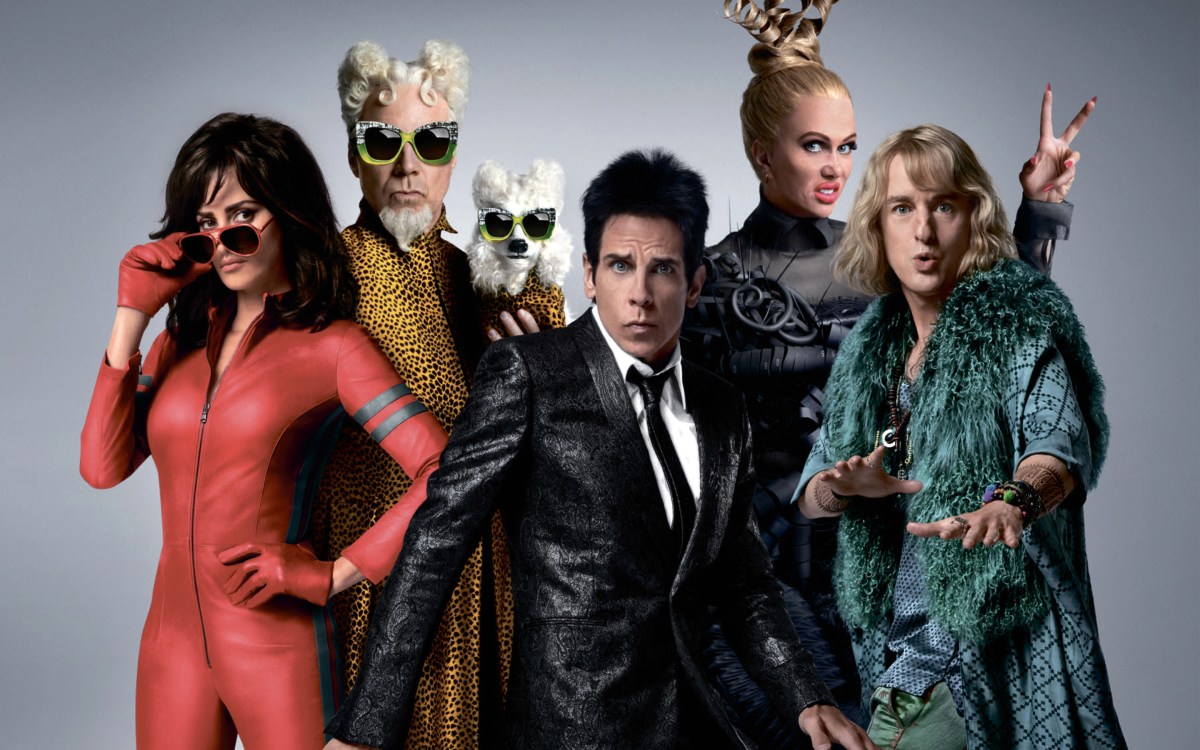
Hi, and welcome to film club. As a special treat tonight we have a review of Zoolander 2 written by the comments section beneath a ‘Jeremy Corbyn for PM’ Facebook post.
Still more electable than Labour
Zoolander 2
Zoolander 2 is the best film ever because it has Ben Stiller in. I hadn’t heard of Ben until I saw this film, but he’s the greatest and all the films he’s in are really funny.
Some idiots are saying that Zoolander 2 isn’t a good film and that The Godfather is better, but when I went to see Zoolander 2 the cinema was full…I’ve never even seen a cinema showing that Godfather film, probably because it only appeals to cinema snobs.
People who say Zoolander 2 isn’t good are going to look pretty stupid when it wins the best comedy Oscar.
Ben Stiller is brilliant in everything. Night at the Museum 2 is rubbish. Ben wasn’t in Night at the Museum 2. Night at the Museum 2 was ages ago. Night at the Museum 2 was really good. Why do Ben haters keep talking about Night at the Museum 2? It wasn’t as bad as Avatar.
Owen Wilson’s a cunt. You can tell he’s just trying to ruin Ben’s film, because he’d rather be at the RSC playing Hamlet or something posh like that. He’s a traitor to actors.
Everyone I know says that Zoolander 2 is the best film ever, and 2 of them are Jewish. So much for anti-Semitism. They even paid to see it!
I used to be a huge Bowie fan, but after he refused to appear in Zoolander 2 I deleted all of his songs that I’d downloaded.
Anybody who didn’t appear in Zoolander 2 shouldn’t be allowed to be in films ever again, simple as!!!
Derek Zoolander is just like Albus Dumbledore and if J K Rowling says he’s not that’s because she can’t see the truth over the piles of money she got from them sell-out Harry Potter films.
I’ve been a fan of Ben ever since he appeared in Daredevil and without that film we wouldn’t have had all the Avengers films. I bet a lot of people who put Ben down really like Captain America: Civil War, and their hipocrassy sickens me!
_____________________
That’s all we have time for right now, but join us next week when people who complain on Facebook about cyclists not paying road tax analyse the use of metaphor in French new wave cinema.
When I started this review I expected it to be one blog post that nobody read, but now it’s stretched out to six blog posts that nobody’s reading. Amazing stuff.
But I feel it’s time for a shake-up. We’re an hour into the film and I’ve probably exhausted the humour of simply describing each scene. Fortunately, as Chuck Palahniuk says, “everything you write is an autobiography”…so I’ve fed the first 7 scenes into a state-of-the-art AI in order to generate a completely authentic simulation of the film’s director, Bill Zebub, to discuss the next instalment of Dickshark…
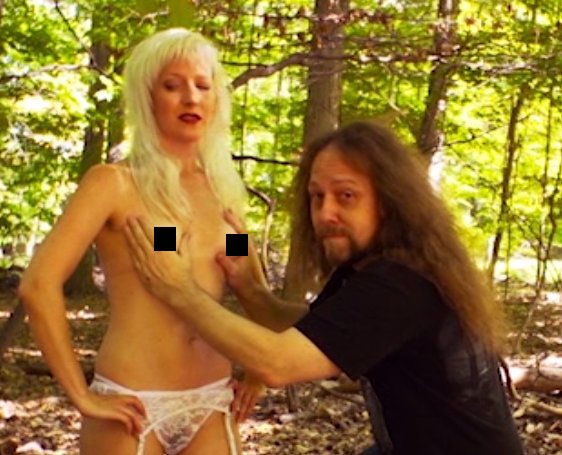
Me: Bill, thank you for joining me tonight. I see that you’ve opened scene 8 with a topless woman in stockings, was there a reason that you chose that as the dominant motif in your work?
Bill: Er…
Me: Once again, we see the female character is unnamed, partially clothed and being groped by a fully-clothed male, your character, Dick. Was it your intention for Dickshark to be such a powerful statement about the objectification of women and the gender imbalance too often inherent in films?
Bill: Um…
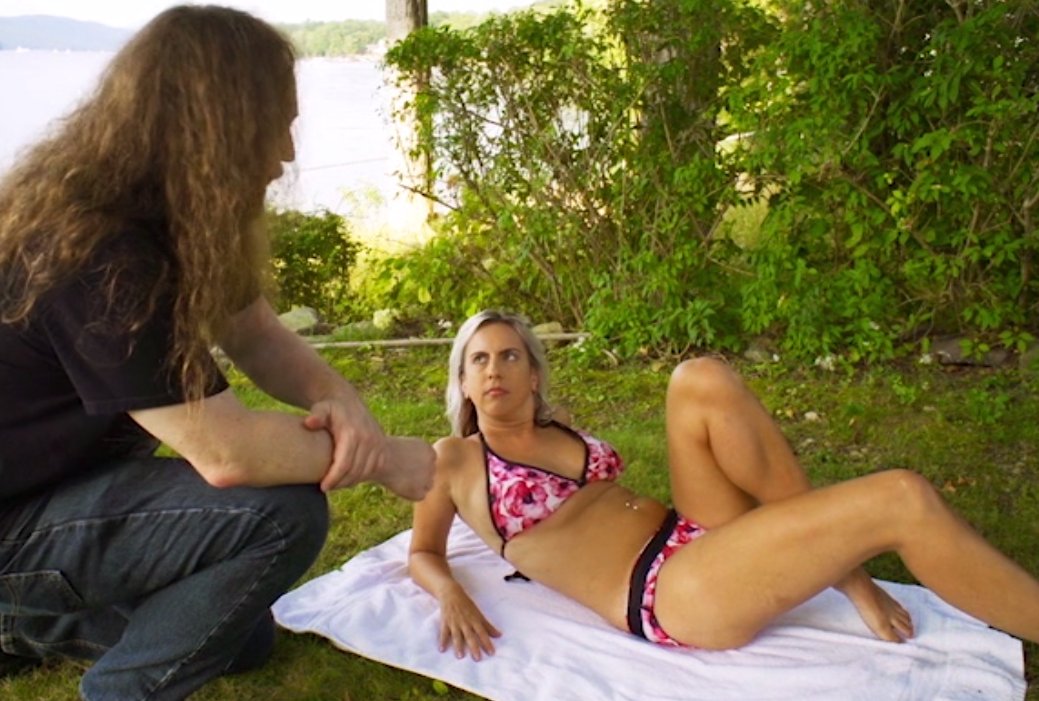
Those expressions, Bill, wow! Were you coached by Hoffman?
Me: The visual imagery is re-enforced by your continued use of no-name heavy metal bands and the background, unless I’m mistaken, is the location from your two previous picnics and one dickshark attack. Did you feel that, as an auteur, you had to make a statement about the repetitiveness of mainstream studio output?
Bill: I…
Me: But let’s move straight on to the opening dialogue of scene 8, “This should make them nice and perky. That way if he has any ability to defend himself these will distract him. It’s a distraction…so distracting”. That’s a line that’s really up there with the all-time great movie quotes, but what message were you trying to get across to your audience?
Bill: Well, um…
Me: That’s great, but obviously what you’re doing is setting up surely the most powerful conversation we’ve yet seen in this film where you accuse the woman of anti-Semitism, because she sarcastically refers to you as ‘Einstein’. Sandwiched, as it is, between a discussion of lesbian rape and the death of a woman at the hands(?) of mutated giant spider, was this your attempt to show that any film can deal with such serious topics if it gets the context and framing right?
Bill: Ah, now…
Me: What comes next, though, is surely your tour de force; you have Dick dismiss the urban legend that we only use 10% of our brains and complain that the belief that this is the case is the fault of the newspapers, for dumbing things down for their audience, “people who have a 3rd grade reading level and no real education”. This is the opening for your lengthy monologue, which starts as a discussion of the origin of the “10%” myth and then expands to take in modern society’s desire for quick fixes in all areas, from dieting through education. You obviously have a powerful need, as a director, to educate your audience, so how did you come up with the brilliant idea of having the camera, rather than focusing on you, the speaker, to instead switch between your co-star’s groin, breasts and buttocks?
Bill: Errrr…
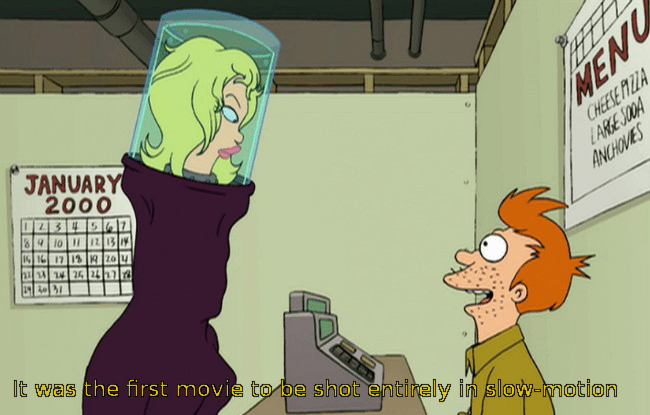
Me: Now, as a viewer, one of the most fascinating aspects of this film is your playfulness with time. In places key sections of the plot – such as Rachel’s murder – are dealt with entirely off-screen and are dealt with in just a sentence or two, in other places you leave in long pauses, tricking the viewer into thinking that you were too half-arsed to edit out missed cues, but…
Bill: You see…
Me: If you could just let me finish…then you deliberately slow time right down, making pointless shots stretch out to what seems like infinity. Almost a deliberate distortion of the film maker’s normal purpose of entertaining the viewer. There’s a prime example in scene 8 where super slow motion is used with a close up to create almost a claustrophobic effect, leaving the viewer time to ask…
Bill: What I…
Me: …when did the actress remove her knickers between the conversation and the 30 or 40 seconds you spend zoomed in on her crotch.
Bill: …
Me: Sorry, Bill, but it seems we’re out of time. I’m gutted that we haven’t been able to cover Colin’s discovery of Vanna’s body, or the film’s 2nd giant-mutant-spider rape, but I’d like to thank you for coming in today to talk to me, and I think we’re all looking forward to scene 9, which I’m sure will be a smashing little scene.
Ever since the stout yeomen of Britain voted, overwhelmingly, to exit the European Union the media seem to have taken delight in questions what our commitment to “Brexit” actually means.
This is nothing short of deliberate obfuscation by our left-wing, Corbyn-idolising press. The basic requirements of Brexit have already been made very clear by The Sun…
The forward thinking young men of The Telegraph have added to that list with their sensible call for the return of imperial weights and measures.
Obviously all of these things need to be part of any sensible Brexit plan, but both newspapers have missed some of the more fundamental issues.
As someone fortunate enough to be born in the greatest decade – the 70s – I did my growing up before the paper-mountain of red-tape from the EU washed over our proud white cliffs and drowned Britain in a literal drought of common sense, so let me tell you how Brexit needs to be defined…
The National Health Service
A lot of sore-losers in the ‘Remain’ camp have been whinging about the busses promising £350 million per week to the NHS and, more specifically about it’s failure to appear…but, let’s be honest, nobody in the Remain or Leave camp really expected it to, did they?
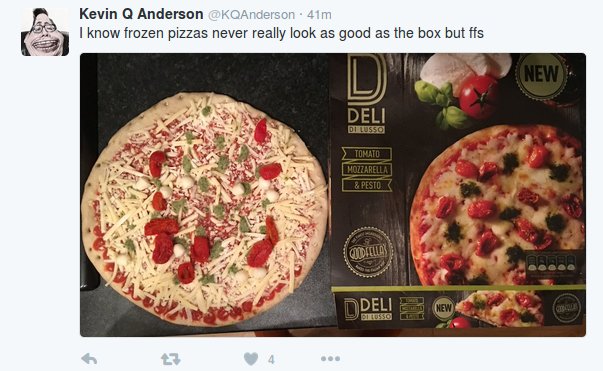
How can I put this without being patronising…ah, yes…when you buy your Asda own-brand frozen meals for one they have a picture on the box. You might even use it to decide which nearly indistinguishable flavour of chemical sludge to buy, but you have no expectation that your finished meal is going to look like that, do you? It won’t be served on a plate, looking like it had just been lovingly prepared by a MasterChef finalist. You won’t have a fine Chablis ready-chilled to drink with it, from cut-glass with beads of condensation forming on the outside. No, you’ll sit in front of the idiot-box and eat it straight from the plastic tray, probably with a warm can of Fosters.
Well, that’s what the £350m/week was…it was a serving suggestion for Leave. Maybe if you get your act together, work a bit harder and increase tax revenues by £30 or £40 billion per annum then you can talk to our magnificent post-Brexit government about spending a bit more on the NHS, but at the moment you haven’t even bothered to buy the sprig of parsley to put on the top.
Stop bloody complaining, you slacker!
What the NHS really needs is a return to the values that made it so great in the first place; big single-sex wards, spending weeks at a time in for a broken leg (with your leg in plaster and held in traction), terrifying matrons and sexy nurses, who always wear black stockings and suspenders.
That’s what the Great British public want, but it was killed dead by the EU’s crazy anti-discrimination rules that opened the way for political correctness gone mad; such as crazy laws that forced hospitals to employ male nurses! You couldn’t make it up!
Nowadays we can only catch a glimpse of the glorious NHS we once had through repeats of the Carry On films and Only when I laugh; where James Bolam went into hospital for a routine appendectomy in 1979 and stayed there until 1982, without anybody thinking it was strange.
Which brings me on to…
Entertainment
The British sense of humour is what binds us as a nation and makes us better than the foreigners, but as the daggers of the EU tightened their stranglehold around our very souls we allowed the great tradition of British comedy to be ruined, and ruined by one word…
“Alternative”
Suddenly our TV screens stopped showing good, family-orientated comedy where we could all have a proper laugh at women losing their clothes, jokes about puffs or people in blackface doing ridiculous accents.
I think all of us alive at the time remember the dark day in 1982 when BBC2 first screened The Young Ones and we knew that the tide had turned on our mighty tanks in the comedy war.
That same year the status quo of British society was rent asunder as the three-channel consensus was rocked by the arrival of Channel 4, the dark overlord of “alternative”. Just 7 years later The Benny Hill Show was cancelled, that was our D-Day…if the British had been Nazis.
Damn it, Benny, you had so much left to give!
Yet the resistance who fought on, brave patriots like Bernard Manning showed that there was still a demand for the comedy that the EU had branded “racist” and “sexist”. Manning could still pack venues, which I’m told is a terribly good indicator of popularity with the general public, and had hordes of admiring fans.
If Brexit means anything it means a return to the three channel system that made Britain what it is and an immediate banning of the cosmopolitan “alternative” comedy, which for so long blighted our youth and made them lazy, stupid and politically uncooperative.
But before I leave behind the topic of racism…
Food, drink and shopping
In the 70s, if you didn’t fancy a proper British take-out of fish & chips, it was perfectly acceptable to nip to the chinkies for a curry and stop at the paki shop on the way home for 20 Benson & Hedges and some McEwan’s lager. If you really wanted to you could buy a bottle of wine instead, and it would give you the sophisticated air of somebody who wished they’d chosen the lager.
If you ate out then you went to a proper restaurant, with a table-cloth, you went to Wimpy for a burger-like meal or you ate chicken in a basket at the pub. You bought your clothes at Marks & Spencers and you never had to worry about being fashionable, because fashions only changed once a decade.
The EU has forced choice upon us, where none was wanted. If has made our life a whirlwind of choices, over which we must surf daily. They have even forced us to show tolerance towards shopkeepers from ethnic minorities…it must be 20 years since I last heard somebody hilariously ask for a “bag of plawn clackers”. That’s no way to live, not for an Englishman.
Conclusion
So there you have it, Mr Davis, aside from The Sun‘s perfectly reasonable list, and The Telegraph‘s call for pounds and ounces (which, I assume, was always going to be a natural consequence of Brexit) all we need are unfeasibly long stays in hospital, tended to by sexy nurses, the immediate cessation of all alternative comedy (a new series of ‘Allo ‘Allo might show our European “friends” that we mean business), an end to tolerance, a massive reduction of choice in everything and a sprig of parsley for frozen meals.
I suppose you should sort out some trade deals as well, but that’s very much a sideshow in the buffet of Brexit.
I hope this has been useful for you next time you speak in parliament.
The actor Sam Coleman, best known for playing the young Hodor in HBO’s Game of Thrones this week published a blog via The Huffington Post, you can read it here.
I’d like to address this blog to him.
Young Hodor, pictured yesterday, in the past
Sam, there’s a lot I disagree with in your blog, but a much of it could be said to be subjective. This, however, is just straight up wrong.
Yes, party membership has increased, but that doesn’t correspond to increase in support for the party in the wider electorate. Polling shows the exact opposite, Labour is haemorrhaging support. It may have attracted new supporters from the non-voting disenfranchised or the ranks of the Greens or the smaller hard-left parties, but it has lost many, many more from the centre ground, which is where the majority of the electorate lie.
Yes, polls can be wrong, but when all of the polls are saying the same thing, and they’re all showing Labour tanking then simply hoping that they’re wrong, and wrong in a way that favours you, isn’t a sensible political strategy.
At the ballot box Labour, for decades the dominant party in Scottish politics, have fallen to be the third party in the Scottish Parliament. There’s no simple “the SNP are more left-wing than Scottish Labour” narrative (they’re not), because Scottish politics are tightly wrapped around the central-pillar of nationalism, and we should be very cautious of trying to unwind them into a simplistic left/right story-line. However, as at the time of writing, polls are showing that traditionally Tory-hating Scotland views Teresa May massively more favourably than Jeremy Corbyn.
I can’t speak for J K Rowling, but the problem that I have with Corbyn isn’t with his policies, but with the absolute fact that if he’s not electable then it doesn’t matter what his policies are. A general election tomorrow would see a vastly increased Tory majority in parliament, enough to force through any changes they wanted to make.
This is the scenario that we’re trying to avoid, a strong Tory party and Labour relegated to a political sideshow, a party of student demonstrations, ineffectual marches and anti-government memes. We’re trying to stop the next government being a Conservative one, because we’ve seen the power that a Labour government has to improve lives.
If you didn’t see J K Rowling’s Twitter-storm on Friday evening, where she lists the achievements of New Labour, the party that you carelessly branded ‘centre-right’ then go and have a look. We traitors, we Blairites, we red Tories, we Zionists, we scum, we want that level of social change again, we just recognise that a level of compromise is necessary to get it.
Labour right now is like a toddler, having a tantrum because it wants the whole cake, not just a slice now and a slice later, if we’re good. The longer we shout and wail the greater the chance that we’re going to get no cake at all.
You’re young and it is the prerogative of the young to be idealistic, but sooner or later the young must learn that the real world isn’t Harry Potter, where the righteous inevitably triumph over evil, but Game of Thrones, where any day could be Labour’s red wedding.
V is sitting at his desk, opposite mine, wearing his usual jeans and t-shirt, his face bright red, his mouth agape. He’s laughing so hard that he’s reached the stage where no sound comes out.
It’s a stark contrast to the first time we met, a little over three years ago, with him wearing his best suit and a nervous expression, clutching a folder of examples of his work from his recently completed degree.
Then he was a fresh graduate, seeking a job. Today he’s watching clips from Father Ted for the first time. Before this year is out I will say ‘goodbye’ to him forever.
In case you’re wondering how somebody can only discover Father Ted by having their colleagues show them YouTube clips on a Friday afternoon in the office it’s because V is Lithuanian. He came to this country to study for his maths degree, paid his way through it by working as a night-porter in a Newcastle hotel and then, afterwards, found himself the subject of one of my haphazard interviews.
If you’ve never recruited anybody for a small company then let me tell you it’s fairly worrying. A covering letter, a CV and an hour’s chat are frightening little from which to judge an applicant’s character. Will they be honest, hard-working and competent? Will they fit in? Will they reflect well on you, the person who hired them? In a company where everyone is on first name terms there’s no place to hide hiring mistakes.
When I phoned V to tell him he’d got the job he told me he needed to give a month’s notice on his night-shift job, but said he could come into the office during the day to get trained up if it would help him when he started. Yes, he really offered to work a whole month without pay, or sleep apparently, so that he could be an effective member of staff from day one.
That commitment hasn’t waned since that phone-call. In a casual office, where most people wander in around 9:15ish, V never arrives later than 8:45, us distracting him with comedy classics aside he doesn’t dick around, he doesn’t take leisurely lunches in the pub, he’s never been off sick, he doesn’t leap up from his desk and sprint away when the day is officially over. Even though he’s working in his 3rd language his written English is perfect and his spoken English is so good that he can communicate with us Geordies!
His hard work, attention to detail and sharp mind have earned him the trust and respect of everyone he’s worked with. After a year with the company he was promoted, and again after another year. He’s now deputy manager of his team, a role he excels in.
Why then will I be saying goodbye to him?
Because of Brexit.
V and his wife want to settle down and raise a family, and it’s hard to do that in an environment where the news still debates whether EU migrants will be forced to leave the UK. They could apply for UK citizenship, and I’d imagine that getting it would be a formality, but V tells me that the problem is that they no longer feel welcome in this country. The mood of the country has changed and immigrants are no longer welcome here.
Imagine that, in our haste to “take control” we’re edging out a hard-working, healthy young couple, who pay their taxes and cost the state nothing.
Now new grad recruits come and new grad recruits go, ultimately a small company in rural Northumberland can’t offer them the salaries and career opportunities of the big companies in the big cities, but to have someone leave because this country, my country, isn’t welcoming is a terrible thing.
I doubt that V and his wife are the only ones leaving. Before any of us know what Brexit will mean for us and country there’s probably an invisible stream of economically productive people quietly packing their bags and heading home.
I doubt that Brexit will bring us anything good, but I am sure that no part of it will make me sadder or more ashamed of my country than Vexit.
Yesterday, in an oddly formatted e-mail, Jeremy Corbyn launched his new digital vision for the UK.
Conspiracy theories being all the rage these days, I’d like to suggest that the bulk of this policy outline forms Jeremy Corbyn’s first onslaught against the person most likely to take the Labour leadership away from him, Jeremy Corbyn.
Corbyn has been leader of the Labour party for just short of one year and, in that time, it’s hard not to feel that we’ve been seeing two different people. The first is very much a flesh and blood man, who struggles to stay on topic, or on policy, when he speaks without notes and who finds talking to the press awkward and often angering. He has a slightly odd turn of phrase, a habit of saying what he thinks without considering the implications and a dislike of confrontation.
The second Corbyn, his on-line presence, is a markedly different voice. It is measured and thoughtful, argues the points or carefully raises new ones as a distraction, presents figures with confidence not necessarily borne from their accuracy and explains away the gaffs of his less competent twin.
Jeremy Corby 2.0, pictured yesterday
This is the essence of Corbyn, surrounded by a shell of advisers and communicators, all meticulously polishing the message, disassociating it from the all too fallible human at its heart.
Yesterday’s digital policy announces the intention of the second Corbyn to kill the first.
Why else headline with the most expensive proposal that will benefit fewest people, the universal access to high-speed broadband? With the Digital Citizen Passport and the Massive Multi-Person On-line Deliberation the intention is clearly to move democracy to the Internet, and one cannot do that until it can be guaranteed that every single person will be able to participate.
Hence the top-of-the-sheet announcement assures us that everybody will have a voice, the digital passport limits that voice to one per person and the online deliberation takes the first step to moving voting online, with every participant given access to the Open Knowledge Library, so that they’re not arguing from a position of ignorance. That all of this will be run on open-source software is a guarantee, of sorts, that we’ll be able to see that it’s all done fairly, that the program isn’t chucking in another couple of million Corbyn supporters every time there’s a vote.
Killed along with the physical presence of Jeremy Corbyn will be his two co-conspirators who have been so embarrassing to the transcendent virtual Corbyn; the mainstream media and parliamentary process.
In moving democracy on-line the Corbyn camp hope to boost the importance of new media, such as The Canary, and bloggers and vloggers, Another Angry Voice and The Artist Taxi-Driver spring to mind, and to diminish the old form of reporting, where people who knew what they were talking about discussed issues with politicians.
And the team that have repeatedly relied upon Corbyn’s leadership mandate as the trump card in any argument get to use the same in parliamentary debates. Why bother debating an issue, when you can just confidently assert that it is the overwhelming will of the British public? Every topic becomes a new Brexit, where we’re told not to discuss any alternatives, because the public have already spoken.
In 7 bullet points then the Corbyn campaign announces its plan to kill Corbyn and create a new world, where the idea of Jeremy Corbyn is separated from the reality of Jeremy Corbyn, and the voice with which he speaks can never die; “Of course not. How could he die? Next question.”
Digital and incorruptible we can be governed in the sure knowledge that nothing can ever go wrong with these digital servicaes